I think you can agree things are looking a bit forlorn on my visit to the allotment today. I keep wondering "Who is that" before remembering that the sunflower is being left for the birds. It is all that is left of the beans and cucurbits (and I think it came in with the plants having originally come from the birdfood at home).
One area still very much in production is the "Other Roots" which is mostly given over to carrots (under environmesh netting) because we eat so many of them over the year and they taste so much better than any you can buy. We haven't even finished harvesting half of them. as we pick them as we need them. I do hope we will get away with leaving them in the ground over winter. The net helps - and I will supplement that with straw if severe frosts are forecast.
Carrots under netting
The rest of the "Other Roots" are parsnips and scorzonera squeezed in at the end. These happily don't need protection. Celeriac had to be squeezed elsewhere (with the cucurbits) as space had run out!
Green tops of "Other Roots"
The Allium area only has leeks left. They have been intercropped with late lettuces, some of which are still on the go - along with the weeds.
Lettuces and Leeks
Harvested lettuces and leeks - and beetroot
Something else still on the go, by design, is curly endive - Pancalieri. I tried these last year tying a string around each plant to blanche them. It worked fine but some insects got wise to my plan and took up residence. So I am being a bit more relaxed (lazy) this year and I have left the rosettes unrestrained. They make great lettuce soup.
New this year is chicory. Rossa di Traveso (I think) is the one that has worked out best. Time will tell if they reach edible proportions.
Rossa di Traveso heads
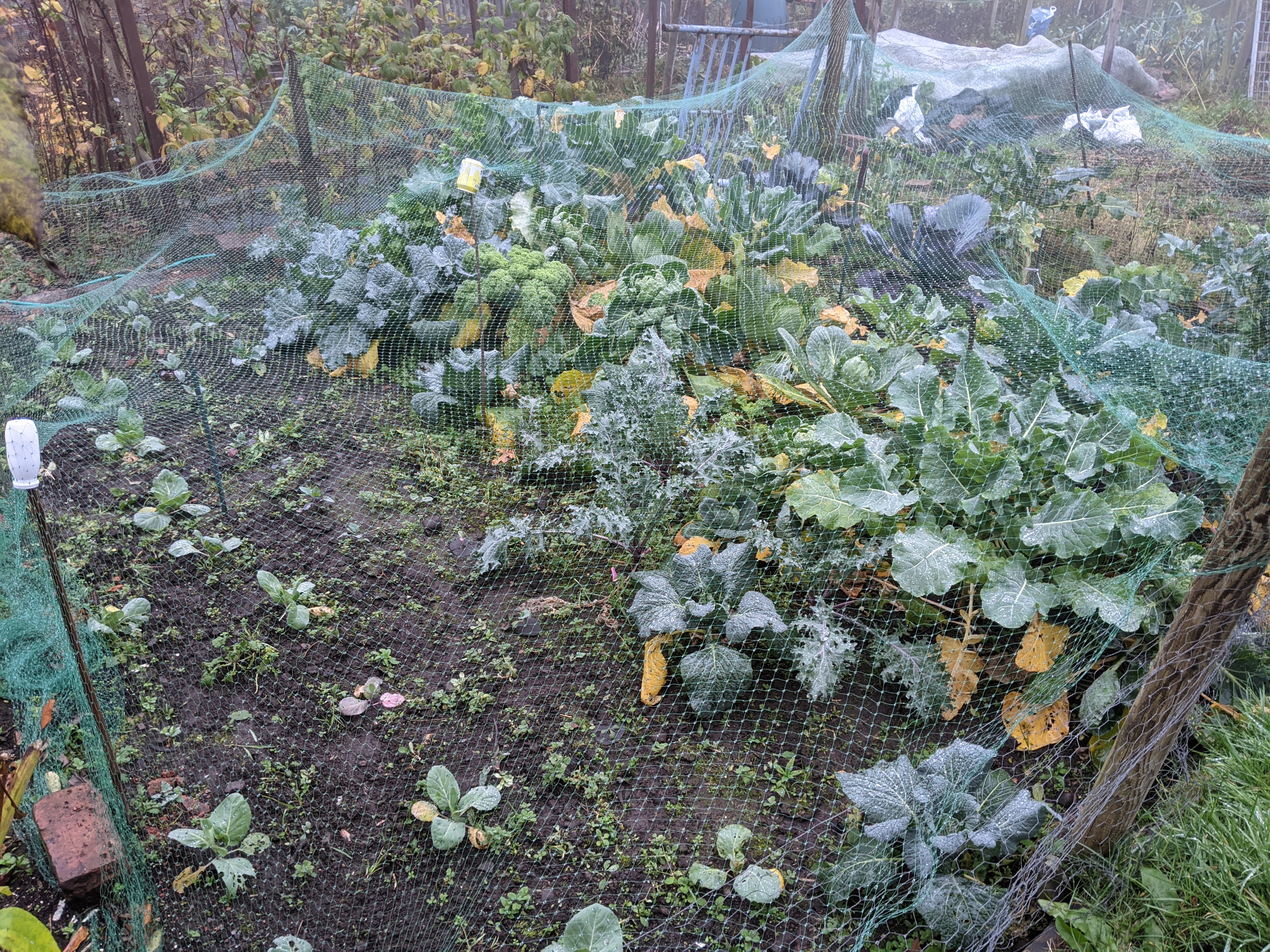
A mention for the more traditional brassica patch. The small plants are Spring Hero cabbages I am overwintering. There's plenty broccoli, sprouts and kale for the winter too, provided the pigeons don't gain access under that net.
Brassica Patch
So even though it is looking murky and winter is approaching there is still the prospect of more to come from the allotment.
When things quieted down at the allotment at the end of September I was glad that I would have more time to invest in my renewed interest in wildflowers. But guess what: It's not just vegetables that stop growing, the rest of the vegetative world also goes into hibernation once days shorten, temperatures drop and the wind and rain arrive. I do have a whole load of snaps taken over the summer that I can review over the winter months but today I am sticking to wildflowers that piqued my interest in October. A floral last hurrah
First prize has to go to Wood Sage. The rugose leaves form a rosette only to be outshone by a spike of creamy yellow flowers leaving an architectural tower of seedpods. I found plenty of it growing on a hilltop near me. Quite odd for a "wood" plant.
Wood Sage - Teucrium scorodonia
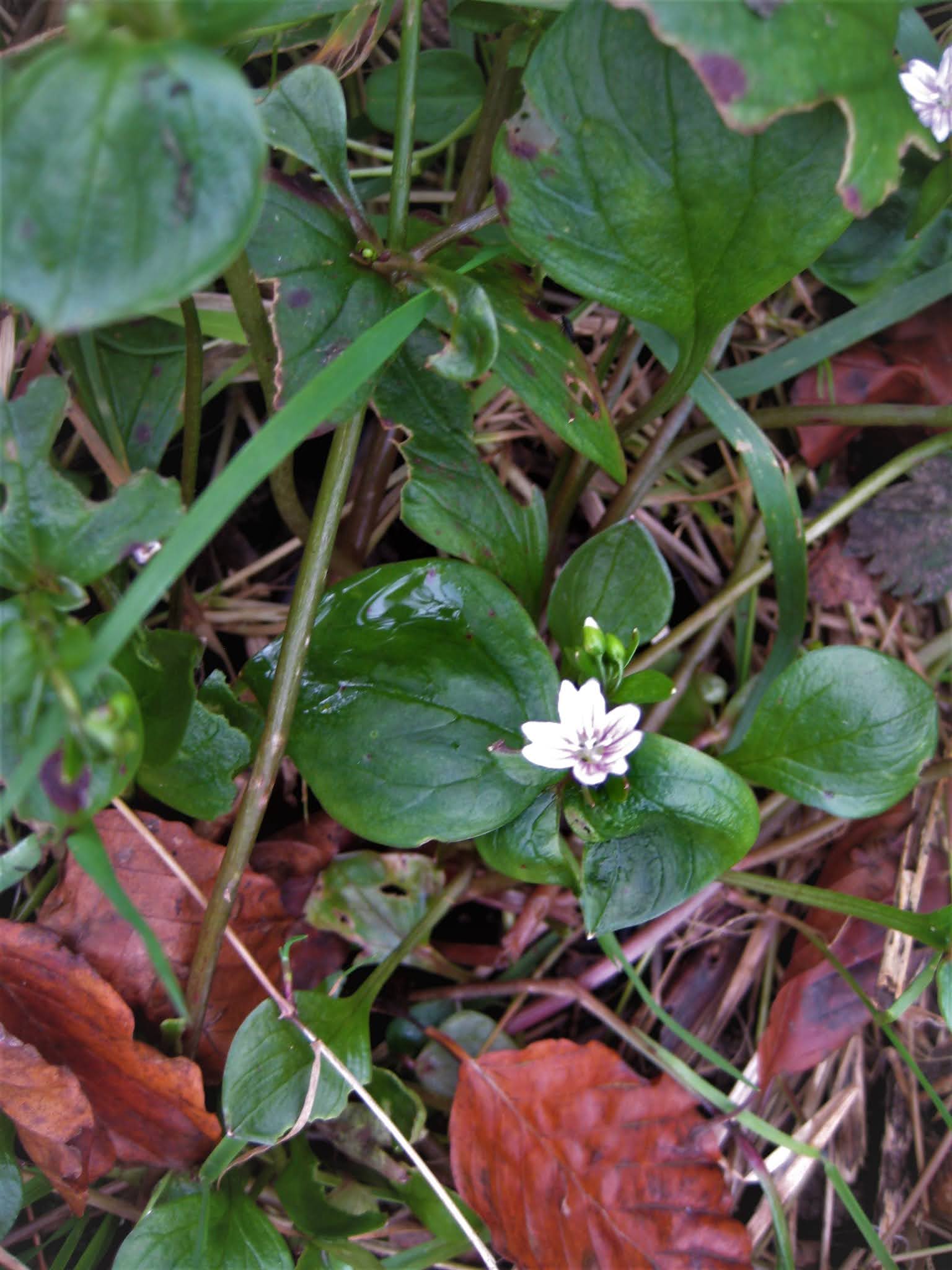
Then I discovered an intriguing white patch with a definite pink tinge in a wayside ditch: Pink Purslane whose leaves are described as like those of the Ace of Spades. 5 divided and deeply notched petals had me mistaking this for a chickweed at first.
Pink Purslane - Claytonia sibirica
Along the same lane I spotted some dramatic nodding heads. The leaves are those of Herb Bennet (Wood Avens) but the flowers are entirely different. Colloquially known as Billy's Buttons this is Water Avens
Water Avens - Geum rivale
There is a cross between Wood Avens and Water Avens: Geum x intermedium. The flowers of the cross are more colourfull and more open. It grows in cracks in the pavement nearby.
My next October flower was definitely a vetch, but which one? Narrow-leaved Vetch fitted the description. Flowers in pairs, uniform in colour (concolorous!) Auricles (ears) either side of the main stem where leaf stalks branch off.
Narrow-leaved Vetch - Vicia sativa ssp nigra
Last on my ramblings is another plant with nodding flowers. Could this be why it is known as the "mourning widow"? With such dramatic flowers it is a pity that they are always pointing downwards.
Geranium phacum
Also known as Dusky Cranes-bill this was on a farm lane - right beside a cottage garden it had, no doubt escaped from.
I hope you have enjoyed sharing some of nature's late show of colour.
Looking back I realise that I started my "worm farm" back in April 2019 See Worm Farm Update. It has been located in the garden shed and survived a winter (and two summers). Today I dismantled it and liberated the residents... to join those already in the compost heap.
I did feel bad about keeping the worms in a closed system where there was no escape, however the community seemed to be thriving so it can't have been that bad. Incidentally the reservoir did not turn into a drowning pool as worms can survive under water for considerable periods of time.
Maintenance consisted of topping up their food supply and draining off the liquor from the reservoir at intervals. This worm pee was used as a liquid feed and I as much, if not moore than I needed, particularly now at the end of the growing season.
So if it was so successful, why am I dismantling it? (I hear you ask).
It was after all just dreamed up to make use of some environmentally not very nice packaging.
There was a build up of white pot worms for a while that worried me. (The more familiar reds did prevail in the long run.)
Tucked away in the shed (and being in a closed system) I had to remember not to forget to feed them at least every few weeks,
I already have another worm farm. It is called the compost heap, This is a dalek style one. Most importantly it is open to the soil at the base, and the worms are free to come and go as they please. Admittedly I lose the liquid fertilizer through the soil, but that is the only negative I can think of. It looks after itself and is very forgiving of holidays, the seasons, and my memeory lapses.
So, as they say, "a no brainer". Liberate myself by liberating the worms!
The season for fungi is here for all to see. I never pick (let alone eat) any. Not having the expertise to identify more than one or two I would have no confidence that I wasn't poisoning myself and those near and dear enough to share a meal with. When it comes to threats to life I like to keep it simple. I do however admire from afar and try to expand my knowledge. So I am enjoying walks and the fungi are putting on a show just as the flowers are being snuffed out by the cold. Here's a woodland flower (as you can tell from the flash being required) that I just had to learn about.
It turns out to be Yellow Pimpernel (Lysmachia nemorum). I can see the similarity to Scarlet Pimpernel, except that likes open spaces and is famous for only opening when it is sunny whereas Yellow lives in the shady woods!
Back at the school it turns out that the council has cut down the wildflower meadow. Not a problem at this time of year but we will need to reinstate the metal stakes and rope demarking the area. (Someone pinched the bright blue rope that was used for this purpose).
The cucurbits have curled up, the beans have been, the lettuce is letting up - it's that time of year again. Time to take stock. What worked - and what didn't?
Worked
Winter Squash
Carrots under nets
Potatoes
Raspberries
Blueberries
Tosca onions from seed
Late season lettuces and Italian Endive varieties
No Go
Sweetcorn - Three strikes and you are out.
Spanish Flag (Ipomoea lobata) and Spanish Dancer (Linaria reticulata)- These belong in Spain and don't like the climate in Edinburgh
French Climbing Beans - no competition for runner beans. Dwarf French beans don't seem to be as sensitive. Curiously Italian Barlotti beans don't seem to be as temperamental. Mind you they are grown for drying not for pods.
French Cornet Endive varieties. Cornet de Bordeaux bolted every time.
I was prompted to post about this vertical pallet garden after reading accounts of other more professional ones. This is located in the school garden and consists of two posts driven into the ground with a wooden pallet slotted over them. Containers are then wired to the pallet slats. Last year we tried a variety of plants, but this year the theme was a mass planting of lobelias. What do you think?
The display was somewhat short lived. Either this is because lobelia roots don't like to be closely contained, or just possibly, the feed of diluted worm pee was too high in nitrogen so they stopped flowering. The lobelia in half barrels in the school playground are still flowering happily away so I venture to think the former. At any rate by the end of August they had stopped flowering.
28 August
And just for the record here is how the vertical garden looked last year when still in development: There was a wider range of plants but none successfully overwintered, aside from the mint at the bottom.
I am not sure this experiment is worth continuing. The watering regime was three times a week (to tie in with three fills of the bird feeders a week). Even if it rains you need to water the lower tiers as they are in a rain shadow. A cynic would say that this experiment has demonstrated why horizontal is the norm for gardens.
Well winter squashes actually. Here's this year's allotment crop
The long yellow ones should be Butternut F1 Hunter, but I think there must have been a mix up with the crossing as these look more like Banana Squash or even Spaghetti Squash. I will report once it has been cut open and cooked.
Not sure whether this is Blue Uchi Kuri or Crown Prince. That will teach me to grow such similar varieties.
Size isn't everything - These cheeky Uchiki Kuri are perfectly sized and one was the first to go under the knife