January flowers are such a rare thing. Thank goodness for the witch hazel
Winter Flowering Cherry
and Winter Jasmine
The bulbs are sprouting green leaves but not even the snowdrop will manage to put in an appearance before January is out.
And on the subject of bulbs I have this week planted 3 rows of garlic at the allotment (to add to the autumn sown ones). Back indoors I have sown 32 broad beans into deep root trainers. These will go into the greenhouse once they emerge and on to the allotment in due course. Yes spring is just around the corner. Next week will be busy now that I have looked out my seeds for early sowing! (Leeks, onions, shallots, tomatoes and chilli, as well as lobelia .
It is a sure sign of summer progressing when your fennel is ready for harvest. After a summer where my focus has been elsewhere I realise it is time to do my "warts and all" tour of the plot.
The parsnips are progressing steadily regardless of the stop start weather. Alongside I have some second sowing of autumn crops where the elephant garlic was.
The fruit cage is looking very green where the gooseberries and redcurrants are, A really good redcurrant crop but only a few gooseberries. I might have been a bit vigorous with my winter pruning? The blackberries and autumn raspberries behind are yet to come. The two summer varieties are finished
Spring planted Onion from sets are flopping over of their own accord. The early leeks behind show no such tendancy.
For the first time I have tried to grow onions from seed too. They are behind the celery and celeriac in this bed. (It is also the first time I have tried to grow celery)
Moving along to the brassica patch there are three distinct phases as indicated by the height of the plants. The early cabbages and cauliflower are all gone but the Brussels remain tall and now suitably distanced.
Further along the beans are hitting their peak. Both Runners.
and Dwarf French
The winter squashes are the sea of green next door to the beans - although there are some flowers. Fruits? So far three marrow sized courgettes.
The foreground bare patch here is where the peas were and are now sown with winter leaves (Land Cress , Claytonia and Lamb's Lettuce.
Bringing up the rear I have hedged my bets trying to establish an asparagus bed but growing strawberries in between - at least until the asparagus gets going. It was grown from seed. (The rhubarb blueberries and globe artichoke just get on with their business year after year.)
The final area is not very pretty, It is the potato patch with nearly all of the tops cut off. It looked like this in the middle of June.
It is raining again today, but yesterday was a surprise sunny day. I took the opportunity to take some snaps of the allotment. First, appropriately, the potato patch.
The shaws are appearing above ground and very soon it will be time to mound them.
Beyond the potatoes is the fruit cage. The first of the three bays was strawberries. Notoriously these have to be moved around in order to avoid build up of disease. So currently this bay is garlic, Elephant to the left, ordinary to the right. In between are two rows of parsnips which are indistinguishable from the germinating weeds currently. But believe me they are there!
The remainder of the fruit cage is more conventionally raspberries and a mixture of currants and berries:
Reaching the turn at the end I am most pleasantly surprised by these autumn planted red onion sets. I had given them up for lost but come the new year they have reappeared and are thriving.
Also at that end are spring planted onion sets (tent to the left ) Carrots (temple to the right) and leeks between them. Next is onions and shallots from seed (I went a bit mad on alliums this year) and the start of the brassica patch in front of that in the picture below.
Working back to the start I have covered the ground, temporarily with weed suppressant fabric. This is going to be the the other half of the brassica patch and the legume/cucurbit patch which currently only has broad beans and a row of peas on the go along with some salads. The runner bean poles are up in readiness but the runner beans are only now germinating back at home.
Broad beans (under netting)
For the sake of completeness here is the last section with strawberries and blueberries to the left, rhubarb to the right and asparagus bed featured in my last post in the middle.
So there you have it. Together with the seedling nursery at home this is my vegetable home! Hope you enjoyed the tour.
The cucurbits have curled up, the beans have been, the lettuce is letting up - it's that time of year again. Time to take stock. What worked - and what didn't?
Worked
Winter Squash
Carrots under nets
Potatoes
Raspberries
Blueberries
Tosca onions from seed
Late season lettuces and Italian Endive varieties
No Go
Sweetcorn - Three strikes and you are out.
Spanish Flag (Ipomoea lobata) and Spanish Dancer (Linaria reticulata)- These belong in Spain and don't like the climate in Edinburgh
French Climbing Beans - no competition for runner beans. Dwarf French beans don't seem to be as sensitive. Curiously Italian Barlotti beans don't seem to be as temperamental. Mind you they are grown for drying not for pods.
French Cornet Endive varieties. Cornet de Bordeaux bolted every time.
Here is the current state of play in my warts and all circuit of the plot:
Rhubarb is at one end (together with a globe artichoke). The bare patch before the blueberry pen and strawberries is my aspiring asparagus patch.
...beyond which is the potato patch...
...then peas and beans (with their scrap heap supports) ...
...climbing beans and cucurbits (currently finding their feet under netting). The cages are protecting celeriac. ...
Beyond that is currently a sight for sore eyes - soon to house sweetcorn and my brassica patch.
That takes you from end to end on one side. Heading back along the other side in the reverse direction you start with the fruit cage. This is three bays (Berries/Raspberries/Strawberries)...
...but the last (former strawberry bay) now has been given over to new salad sowings...
We are big on carrots - but so is the carrot root fly so they have to be covered .
Bringing up the rear are the alliums. Onions to the left, garlic and elephant garlic to the right.
Today it was time to harvest the overwintered alliums. After a dry spell we are forecast some rain every day for the rest of the week. Perhaps I should not be as surprised that the homegrown variety performed so well. This is Doocot with parentage grown in Elgin, Scotland (not far from Inverness). Sold as "really garlicky garlic" I couldn't resist locally sourced stock.
Scottish grown 'Doocot'
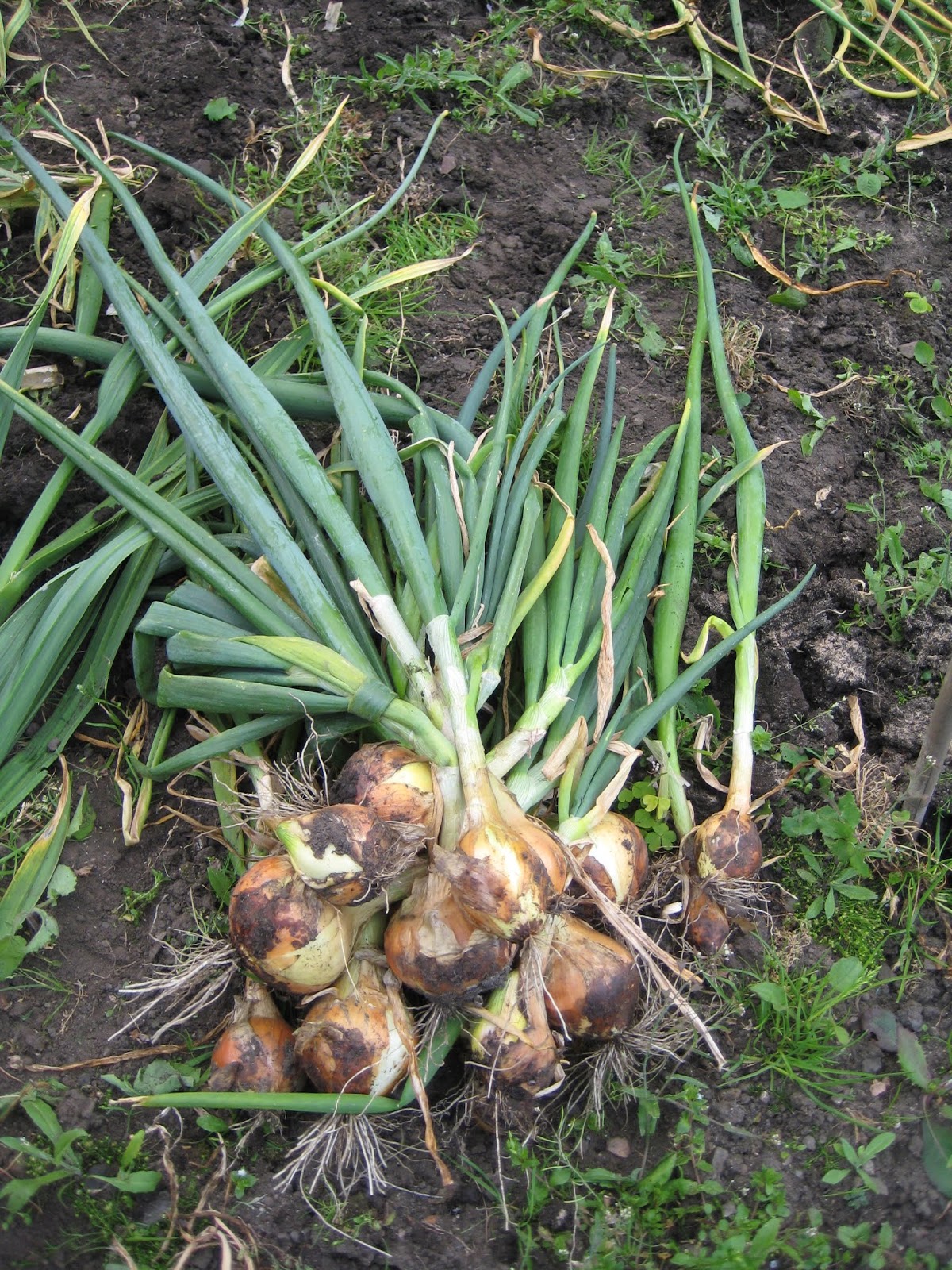
Originating from the other side of the world Shenshu Yellow is a proven overwinter performer.
Japanese onion variety Shenshu Yellow
Our elephant garlic is another proven performer. We keep our own cloves for planting each year. This must be about 8 generations down from the first (single) clove we bought.
Elephant Garlic = African or Indian?
It must be noted that we have more uncloven bulbs than usual this year, probably down to the mild winter.
Last but not least is the Early Purple Wight. Some good bulbs, some showing signs of rot.
Early Purple from the Isle of Wight
I have to point out that I consider it an achievement to get an allium harvest at all in Edinburgh. Every row has some gaps and despite adding a handful of sand per clove when planting some succumb to rot. But this year it has been worth it!
Finally getting towards the end of the carrots. These have been left in the ground, but covered with straw, throughout the winter.
Also covered with straw - but only recently - rhubarb. The bin went on in February, but I had plenty of straw doing nothing.
Another overwintered crop, but one not requiring any protection, is Jerusalem artichoke. These reached 10ft high and were chopped down in two stages. First to about 6ft to protect them from wind damage, and then to two foot after the frost had killed off the tops. The yield is phenomenal - at least twenty fold. There's only one problem: the limit to the number of times you can serve up artichoke soup before rebellion sets in.
Jerusalem artechokes
The autumn sown broad beans failed, but these autumn sown onions look like they have survived and have started growing away!