January flowers are such a rare thing. Thank goodness for the witch hazel
Winter Flowering Cherry
and Winter Jasmine
The bulbs are sprouting green leaves but not even the snowdrop will manage to put in an appearance before January is out.
And on the subject of bulbs I have this week planted 3 rows of garlic at the allotment (to add to the autumn sown ones). Back indoors I have sown 32 broad beans into deep root trainers. These will go into the greenhouse once they emerge and on to the allotment in due course. Yes spring is just around the corner. Next week will be busy now that I have looked out my seeds for early sowing! (Leeks, onions, shallots, tomatoes and chilli, as well as lobelia .
The weatherman advises that the risk of frost is past! It's time to release those cramped plants from their night time confinement in the greenhouse. 20 cucurbits went off to the school garden today. More to the allotment over the weekend. Time to sow the sweetcorn. Time to reconfigure the greenhouse shelves for tomatoes and peppers and cucumber. Also the last impediment to direct sowing has been removed.
Cucurbits for the Allotment
Dwarf French Beans and Italian Climbers (Barlotti)
Peas and leeks at the ready
Brassica seedlings
A selection of flower seedlings itching to be released!
The song should be "Happy Days Are Here Again" but I have gone for something more contemporary:
All the alliums and other hardy veg has been moved to the path outdoors. And here is an unheated propagator with spring salads that gets the lid popped back on at night.
Everything is labelled
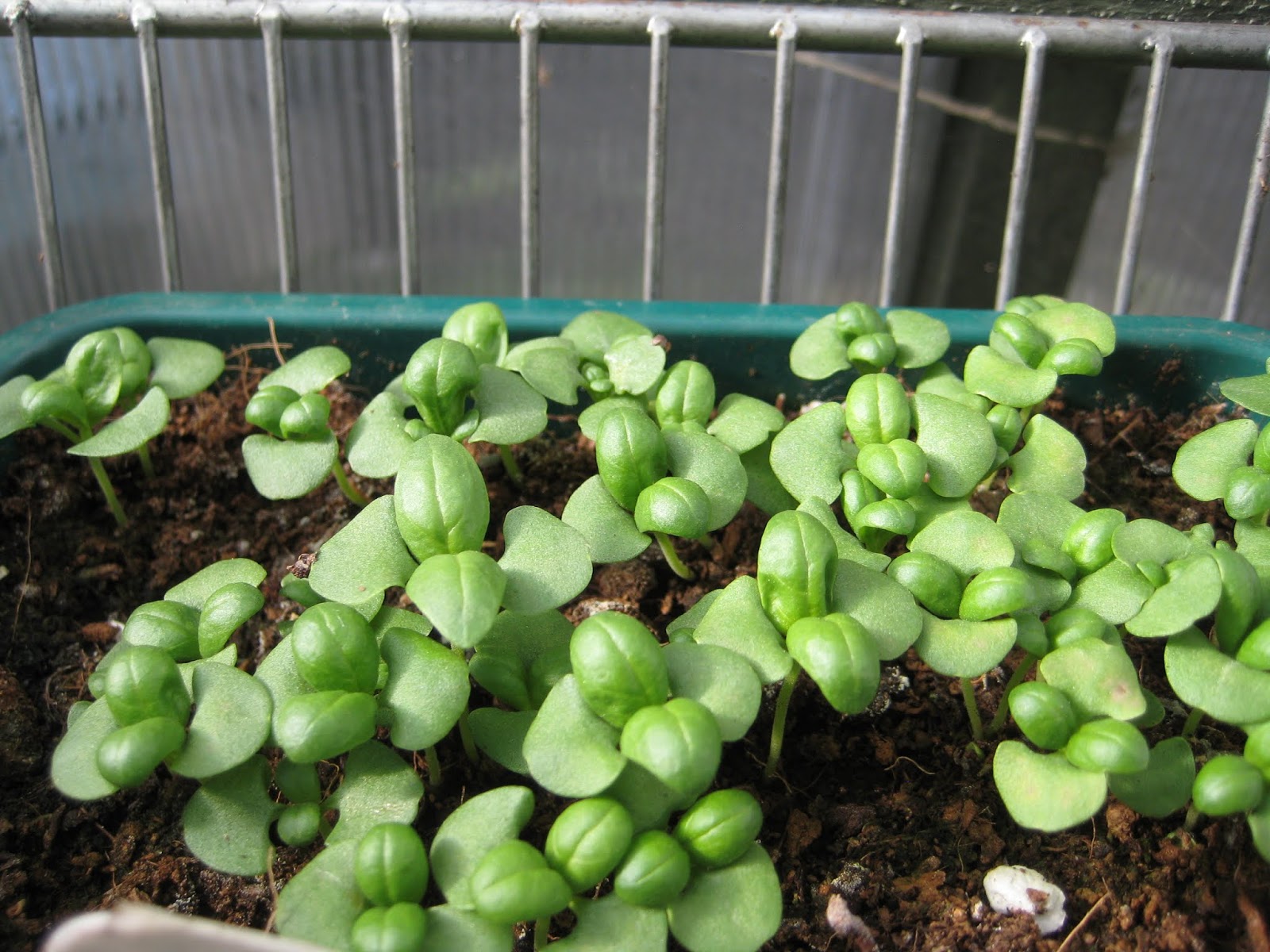
Up above I am delighted with the progress of my basil seedlings!
Living in Scotland I might be a bit rash growing frost sensitive plants so early in the year. The other side of the coin is that the short growing season means you have to make an early start to stand a chance of a harvest. It looks like this year I have got away with it. Tonight the temperature is set to drop to one or two degrees and I will be dragging everything I can fit into the greenhouse, shed and coal cellar for the last time. (The greenhouse gets the benefit of a paraffin heater if there is a threat of frost.) After that the minimum night temperature is set to be no lower than 4 degrees C until the end of the month. I will, of course be checking the forecasters don't change their prediction, but it looks like everything will left in the same place day and night hereafter. Just as well as there are more seedlings indoors under lights waiting to be pricked out.
This year I have deployed conventional light to stop my seedlings getting too leggy. It seems to be working for these annuals which currently have light but no extra heat. (The lights are located in our coal cellar). New this year is a new LED light setup. It is made up of small red and blue lights which explains the funny colour of these pics:
But it seems to work for tomatoes:
and peppers:
Outside in the (unheated) greenhouse transplanted lobelia ...
...and other hardier plants...
Leeks
...have rapidly been moved on after tricking them into germinating indoors!
Broad Beans
It is always a juggling act finding protected space once seedlings require transplanting into bigger containers. The greenhouse is the last resort and offers shelter from wind and rain/hail/snow but is no protection from the cold. I have a paraffin heater at the ready and will be keeping a watchful eye out for any sub zero predicted overnight temperature once the non hardy plants take up residence.
Here's the motley crew that are just waiting to be set out in the greenhouse. They are in the green room (shed) while the greenhouse is set up for the summer season:
Much less cluttered now that the seedlings have been evicted:
We have had so much rain in the last week that watering has not been an issue even for new sowings and plantings at the allotment (of which more to follow). It is warm enough for even tender plants to survive outdoors so I have been moving everything along apace.
Today, at the school garden, I lifted the fleece on the salad bed:
This is where the peas and beans grew this year, but then we planted out plug plants at the beginning of September. The fleece was deployed in the middle of October just before the first frost arrived.
In the foreground the Mizuna is looking nice and frilly. At the other end the Land Cress or American Cress is thriving :
Land Cress
This provides a peppery aftertaste. When the children were sampling the salads last week I warned them off this, and didn't provide any tasting samples for them. The result was that it became the highlight of the session with, I think, every child trying it just to prove me wrong, or to prove they weren't wimps!
There were four sorts of lettuce, with the Marveille de Quatre Saisons stealing the show with its rouged leaves.
Lettuces
The most prolific salad has been Winter Purslane (Claytonia, Miners' Lettuce). Still mild despite starting to flower.
Winter Purslane
I've tucked them all up again under the fleece and it is going to be interesting to see how they do when winter bites. I will leave them to see if we get a new flush come spring. As this is going to be the brassica bed next year there is no rush to clear the ground.
Just while I am on the subject of summer crops I can't resist showing of the solitary chilli from last year. It was an unsuccessful experiment for me spanning some four varieties. I did learn that they really do need to be treated as indoor plants in Scotland. The unheated greenhouse was ok for tomatoes and cucumber but the chillis just refused to grow. Add to this my over enthusiastic watering (in a vain attempt to encourage growth) and you can understand why they protested. It was only when I brought them back indoors that this one fruit eventually ripened.
As you see the leaves are protesting about the cold nights. Despite all this I will try again next year, in a limited indoor windowsill way, to grow chillies.