Showing posts with label worms. Show all posts

Thursday, 29 October 2020

Freedom for Worms


Freedom !

Looking back I realise that I started my "worm farm" back in April 2019 See  Worm Farm Update.  It has been located in the garden shed and survived a winter (and two summers).  Today I dismantled it and liberated the residents... to join those already in the compost heap. 

I did feel bad about keeping the worms in a closed system where there was no escape, however the community seemed to be thriving so it can't have been that bad.   Incidentally the reservoir did not turn into a drowning pool as worms can survive under water for considerable periods of time.  

Maintenance consisted of topping up their food supply and draining off the liquor from the reservoir at intervals.  This worm pee was used as a liquid feed and I as much, if not moore than I needed, particularly now at the end of the growing season.

So if it was so successful, why am I dismantling it?  (I hear you ask). 

  •  It was after all just dreamed up to make use of some environmentally not very nice packaging.
  • There was a build up of white pot worms for a while that worried me.  (The more familiar reds did prevail in the long run.)
  • Tucked away in the shed (and being in a closed system)  I had to remember not to forget to feed them at least every few weeks,
  • I already have another worm farm.  It is called the compost heap, This is a dalek style one.  Most importantly it is open to the soil at the base, and the worms are free to come and go as they please.  Admittedly I lose the liquid fertilizer through the soil, but that is the only negative I can think of.  It looks after itself and is very forgiving of holidays, the seasons, and my memeory lapses.
So, as they say, "a no brainer".  Liberate myself by liberating the worms!


Sunday, 5 April 2020

Old Bag Sees Light of Day

Today I am following up my  3rd December post when I added a "compostable" bag to the compost bin.  It is now four months on (rather than three) so it is time to assess the breakdown.  Taking the trusty trowel in hand I started my forensic excavation. Here is what I found:


Now compare that with the pristine beginning:


To be honest I am not really impressed with compostability. I don't think these residents were very impressed either!


Friday, 24 January 2020

Worms and Weed Suppressant Fabric


Today I conducted a worm survey on my allotment.  I chose three locations. Firstly on ground which had been covered with weed suppressant fabric and was not used to grow a  crop in the last growing season.


Second was an uncovered patch that had gone a bit wild after the legumes and squashes had been harvested


The third sampling site was patch where onions and beetroot had been grown and was not heavy with weeds.


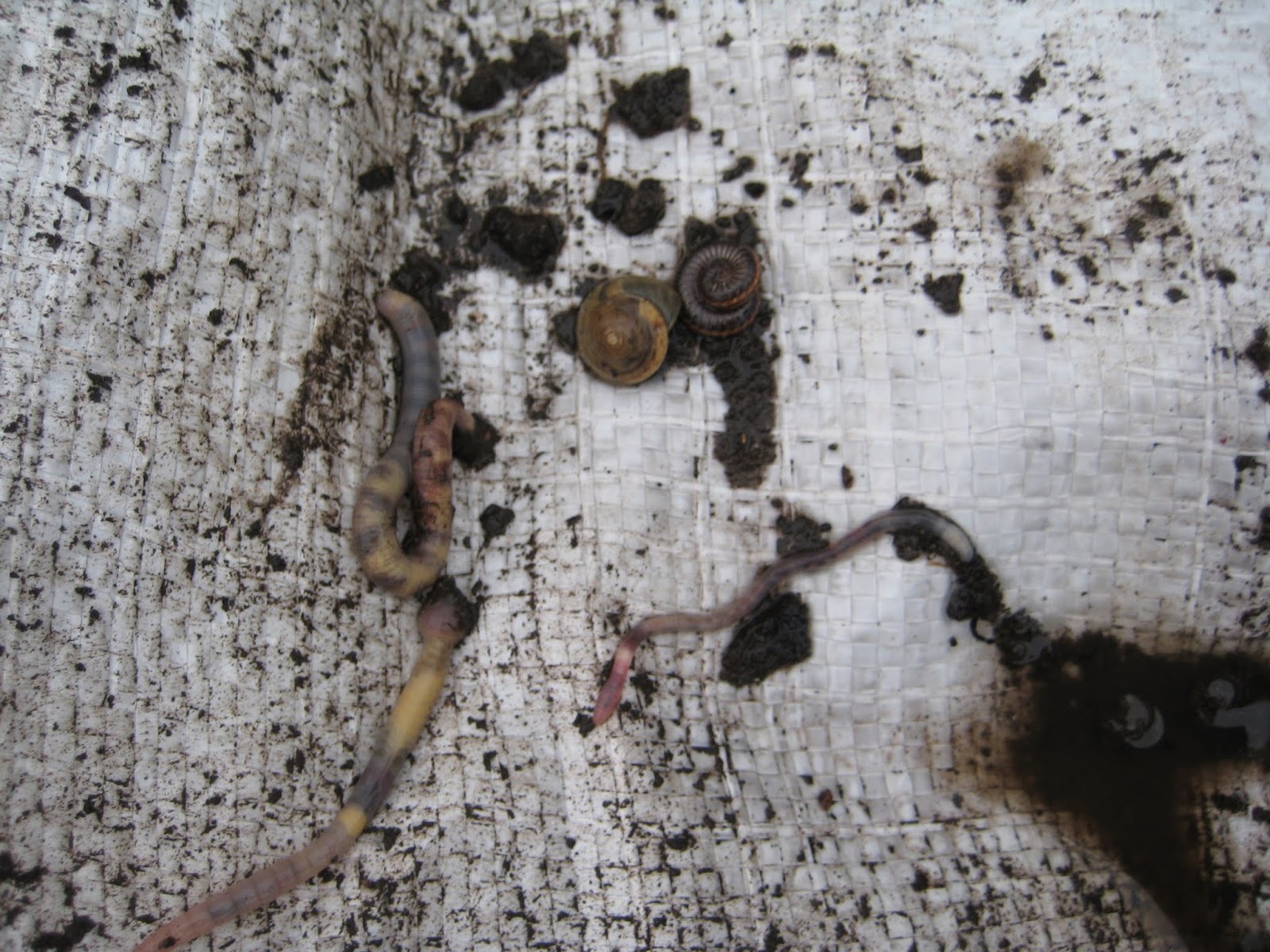
At each location I dugout a cube ( spade's width and depth) of soil onto a white plastic sheet.  Then I sifted through by hand using a spatula (a toy sandpit spade actually) and counted the worms that were big enough to be visible.  The first observation as that there were precious few earthworms at any of the three sites.  Sources talk about 5 to 25 worms per square foot, but I only counted a total of 8 (not counting a centipede, millepede, wireworm and a snail.

The fabric covered area was the worst, yielding just one very pink knotted worm (see top photo). The other two sites were close although the less weedy site just edged it at 4 genuine earthworm.

Overall I am worried at how few worms I turned up.  The original aim of this survey was to attempt to assess the effect of weed suppressant fabric on soil health, as indicated by the number of earthworms.  Just one worm is a fairly clear result.  This is not a result I welcome as I have found the fabric to be a boon, saving me lots of hours of weeding while producing good yields (of sweetcorn strawberries and brassicas for instance).   I may repeat my survey in wetter weather.  (The normal Edinburgh torrent has abated for the last week.) But it looks to me that I should stop using the fabric, except in desperation.


Thursday, 23 May 2019

Vermiculture Revisited


After eight weeks it is time to assess the worm farm.

Opening it up it was wriggling with life but worms are shy of light and soon darted 'underground'.


Top Draw
 For the most part they had abandoned the middle draw.  Any I came across were retrieved and retained in the farm
Middle Draw
This is the first time I have seen worms in the bottom draw. Some fell in as I dismantled the farm, but some must have made their way there and drowned.

Bottom Draw

Surprisingly the newspaper laid down as a liner at the bottom of the middle draw was still intact.
Middle Draw Contents Inverted
It's not much to show for eight weeks but it hasn't been much trouble. So now I have tipped out the middle draw and made it the new top draw, where new 'food' is added.


A knot of worms in the top draw.


Friday, 15 March 2019

Wiggle Wiggle Wiggle... Vermiculture


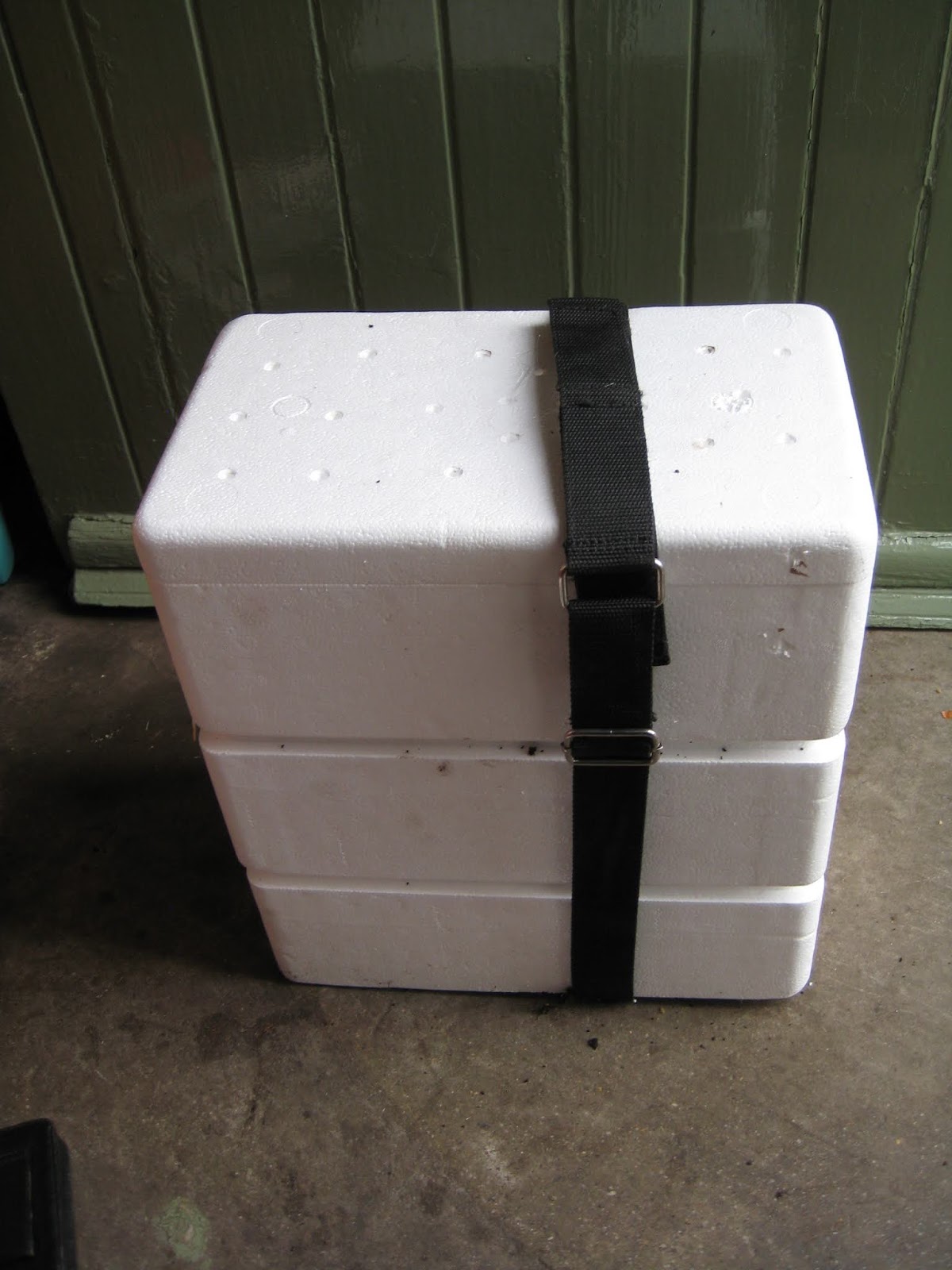
We received a  very generous Christmas present of cheeses delivered over three months.  Each delivery is made with an ice pack in a polystyrene box so that the cheeses arrive in peak condition.  The question arises: what to do with the box?  Well three well insulated stacking boxes is just the right number for a wormery! 

The bottom box needs to be watertight (to catch the "worm tea") but the the top two boxes need holes to allow the air to circulate - and the worms too.  The lid needs holes to allow the air in. So it is out with the trusty soldering iron to make those holes.

Next add worms to the middle box.  No problem as we have a plentiful supply from our maturing dalek composter.  Sure enough it is teaming with them. Along with them comes a layer of "bedding" - partially composted material.  The  worms will soon settle down in their familiar environment, although it is going to be a bit warmer in their new indoor location which they should love.


Next, some new food for them to get to work on, still in the middle box sitting on top of the bottom "reservoir" box:


The third box sits on top.  Once the worms settle into the middle box and grow out of it their food will be added to this box and the worms will move up into this chamber.  Soon after the  worms have departed for their new pasture the middle box can be removed and then emptied so that the top box becomes the new middle box.  The emptied box becomes the new top box.  The bottom box will need to be monitored and worm tea decanted from time to time too.


That's the theory.  Let's just test it out.


Now what tune could cover all the bases on this topic?


Saturday, 9 February 2019

Invasion Earth - Worm Composting

In order to turn this:


into this


you need a bit of help from these:


Today I decided to empty my mature 'dalek' composter so that I could start filling it afresh and leave the current one (I do have two you see), which is full to brimming, to rot down.


Current Composter
Current contents revealed


Mature composter
Mature contents revealed
Aside from the full capacity I have been prompted to record this event by a most interesting post on another blog.  Hot Composting


In the course of the ensuing discussion  I realised that I don't precisely know how long it takes me to fill one bin and move on to the next.  So in some ways this post is a stake in the ground to remind me of the date I stopped adding to the current (green) dalek. The clock is now running!  A really interesting comparison would be to run one bin with worms and one without, but I don't have the means to do that at present so that will have to wait.  As the worms seem to appear like magic it might not be that easy to engineer the no worm scenario.

Currently we are still in the grips of winter and worm activity will be focused primarily on survival. The will have migrated to the centre of the bin and not be feeding so much.  Once temperatures rise there will be a lot more activity and consumption.  The worms pictured above are escapees from the mature bin.  There's not much future in mining that pile (although there are still a few hundred hidden away within).

In case you are wondering I store cardboard alongside the bin where it gets rained on and is to hand when I consider the balance between browns and greens (or carbon nitrogen ratio) needs redressing.  This is very subjective, as is the addition of water if I consider the mix has got to dry.  If the worms are all on the top it is definitely too wet  and if I start seeing ants that signals to me that it is far too dry. 

I feed my compost bins with kitchen waste  - about a caddy a day.  Coffee grounds, tea leaves, vegetable trimmings, excess cooked vegetables and paper all go in, fats, dairy, meat and bones are all excluded - they go into the Council food recycling caddy.