Stuck indoors today because of the rain (hurray) gives me the opportunity to review recent progress. The garlic crops, both winter and spring plantings have been a bit underwhelming. The autumn planted Elephant Garlic and home saved Early Purple Wight and Doocot I feel more forgiving toward. The spring planted Mersley Wight and Solent Wight got all the room and feed they required but turned yellow in early July. Digging them up they were small, showed signs of white rot and in many case developed as two stems intertwined below ground level. While I will continue to grow my own Elephant garlic I don't think the return on the traditional sized garlic is worth it on my plot. Lesson learnt. The picture shows the portion of the harvest that justified storage. Elephant garlic on the left, other autumn planted middle and spring planted on the right. The more fiddly smaller bulbs are still drying off in the greenhouse awaiting assessment for rot and suitability for cooking.
Despite the heat and dry conditions the brassica patch seems to be full and ready for the coming (cooler) brassica season. The thin row is Swedes. To the right are the winter harvested kales. Now that we have had rain I am confident that they will survive to maturity.
Although a bit out of date this last picture is indicative of what is harvesting now. Broad beans have been great and I have staggered further sowings. Courgettes are now harvesting in torrents. Peas have been great this year, and again I have further plantings to come. Raspberries have been ripening daily. That is one days worth of ripened berries.
So all in all I have been very happy with the produce so far this year, even though drought conditions have prevailed until yesterday.
It is raining again today, but yesterday was a surprise sunny day. I took the opportunity to take some snaps of the allotment. First, appropriately, the potato patch.
The shaws are appearing above ground and very soon it will be time to mound them.
Beyond the potatoes is the fruit cage. The first of the three bays was strawberries. Notoriously these have to be moved around in order to avoid build up of disease. So currently this bay is garlic, Elephant to the left, ordinary to the right. In between are two rows of parsnips which are indistinguishable from the germinating weeds currently. But believe me they are there!
The remainder of the fruit cage is more conventionally raspberries and a mixture of currants and berries:
Reaching the turn at the end I am most pleasantly surprised by these autumn planted red onion sets. I had given them up for lost but come the new year they have reappeared and are thriving.
Also at that end are spring planted onion sets (tent to the left ) Carrots (temple to the right) and leeks between them. Next is onions and shallots from seed (I went a bit mad on alliums this year) and the start of the brassica patch in front of that in the picture below.
Working back to the start I have covered the ground, temporarily with weed suppressant fabric. This is going to be the the other half of the brassica patch and the legume/cucurbit patch which currently only has broad beans and a row of peas on the go along with some salads. The runner bean poles are up in readiness but the runner beans are only now germinating back at home.
Broad beans (under netting)
For the sake of completeness here is the last section with strawberries and blueberries to the left, rhubarb to the right and asparagus bed featured in my last post in the middle.
So there you have it. Together with the seedling nursery at home this is my vegetable home! Hope you enjoyed the tour.
The cucurbits have curled up, the beans have been, the lettuce is letting up - it's that time of year again. Time to take stock. What worked - and what didn't?
Worked
Winter Squash
Carrots under nets
Potatoes
Raspberries
Blueberries
Tosca onions from seed
Late season lettuces and Italian Endive varieties
No Go
Sweetcorn - Three strikes and you are out.
Spanish Flag (Ipomoea lobata) and Spanish Dancer (Linaria reticulata)- These belong in Spain and don't like the climate in Edinburgh
French Climbing Beans - no competition for runner beans. Dwarf French beans don't seem to be as sensitive. Curiously Italian Barlotti beans don't seem to be as temperamental. Mind you they are grown for drying not for pods.
French Cornet Endive varieties. Cornet de Bordeaux bolted every time.
Be they red, blue, black or green the berries are most welcome at this time of year.
Black? The blackcurrants seem to be enjoying a bumper year. What surprised me was that the fruit appeared from tip to toe of each branch. Here is a picture taken at ground level:
The reason for my surprise was that I have always understood that you want to encourage new growth from ground level with blackcurrants and prune accordingly. The newer plant (set out in November 2018) didn't yield half as much as the older plants like this one, which also had larger berries. Have I misunderstood the advice I wonder?
It's a new month - and harvesting has started! The Raspberries competed with the lettuce thinnings but now the big guns are out:
First Early Potatoes
Add caption
Three courgettes do not a glut make. But once you have three it won't be long before you have 30. The raspberries in this picture represent those that ripened overnight between two rather wet and dull days!
On the frost carpeted grass are the last pickings of raspberries and runner beans and the remnants of the tomato harvest that has been sitting it out in an unheated greenhouse at the school garden. Ironically the one BIG pumpkin has been given away to the nursery class so is missing from the picture.
To make amends for this omission here is pretty much the entire pumpkin crop gathered from our allotment. I had a big push on cucurbits, but it looks like I chose the wrong year to do that*. The result is one fruit from each plant that survived. There is the traditional orange pumpkin (only just turning orange), Uchi Kuri, Kabotcha and Butternut squash Hunter. Oh yes, two random Sharksfin Melon also made a surprise appearance. Now they are scary. I was surprised to see these on Gardeners World a few weeks ago and even more surprised to see the intrepid presenter sampling them raw. Like a mature marrow, but more dense, they definitely need to be cooked!
*The other 2019 push was sweetcorn. I grew three varieties and ended up with a unanimous raspberry: They don't like the cold and never quite made it to edible proportions.
Having been away for the weekend it was a case of reacquainting myself with the state of play at the plot. Soft fruit is now cropping heavily.
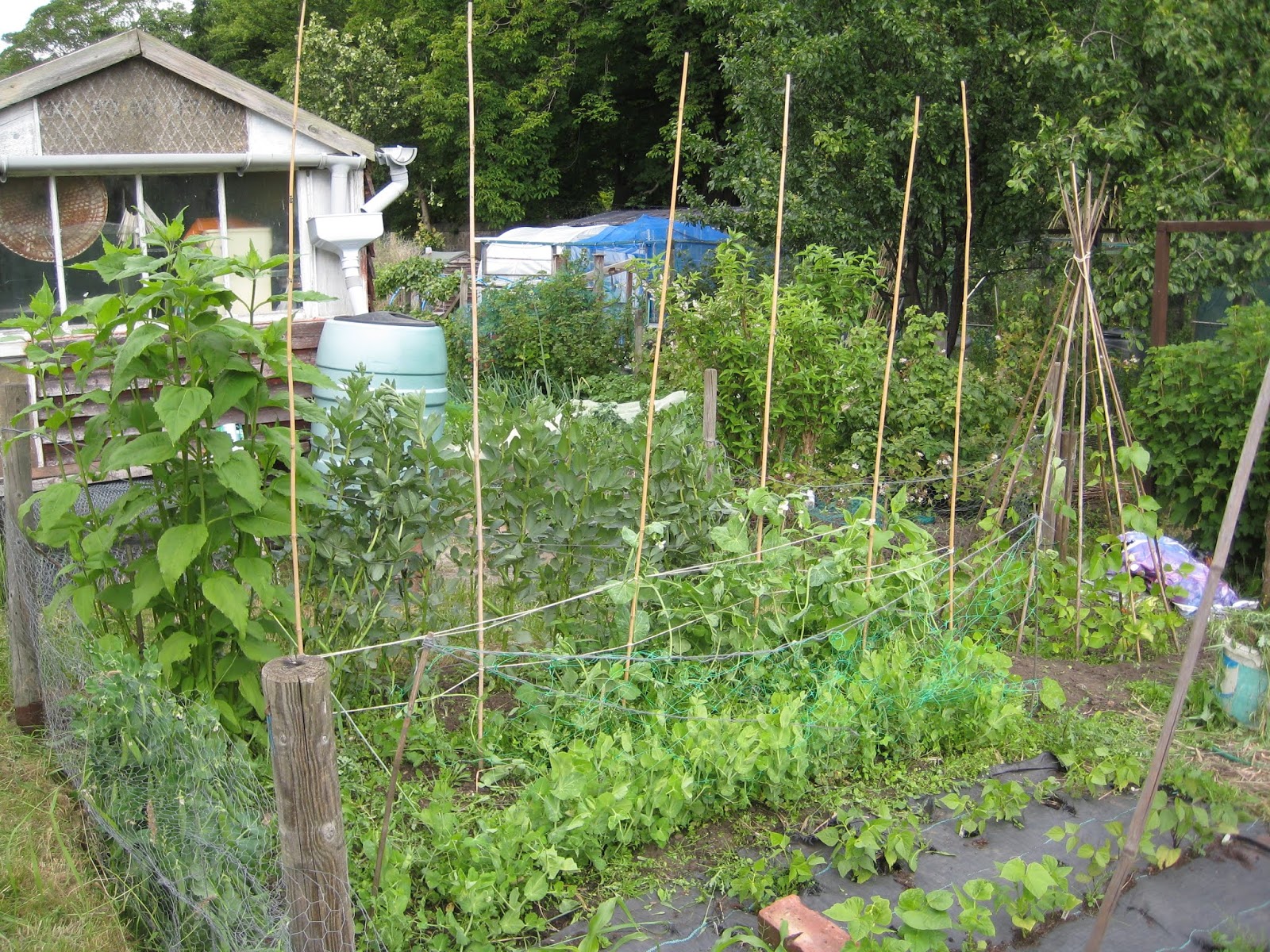
Legumes are on their way but needed support and weeding. Potatoes second early potatoes are flowering and it is time to start on the earlies. (The single Jerusalem artichoke, in the corner, is the odd one out here. I have decided to treat this as a perennial rather than moving it around with the rotation). The runner beans are shooting up the poles, higher and higher.
It is time for my warts and all annual review. Viewed from the East it is not very photogenic.
The view from the East End
In the foreground you have rows of brassicas (turnips, kohlrabi and swede) which I have as catch crops between the asparagus. Very few asparagus fronds came up after the last winter. I will be filling in the gaps next spring. Beyond the "asparagus bed" are next year's strawberries (Malwena) and a row of cucurbits. Aside from the Romanesco Courgette bush there is little to show. Beyond that is:
Sweetcorn
Sweetcorn. Really just an exercise in thumbing the nose at the naysayers who don't think it could possibly be grown in Scotland. It can - just!
Beets and Fennel
Beyond that we are on safer territory with beetroot, fennel, Swiss chard and lettuces. The beetroot this year has been very boistrous and I am hopeful that some of the bigger "roots" will survive well into the winter. Once they get gnawed though they won't keep, so some will be coming home for home storage in the coal cellar. Next is the remnants of the allium patch. Just a few shallots from seed left aside from the stalwart leeks. Beyond that is...
Allium Patch
The carrot temple. Looks rubbish but is the key to keeping the crop free from the tunnelling root fly maggot.
Carrot Temple
On past a row of scorzonera I am growing for a laugh, there is a solitary parsnip and 4 half haearted celeriacs. Then 3 rows of winter spinach (Amazon/Medina/Winter Giant) Only sown recently I want to see if any can survive rhe ravages of winter.
Spinach + Parsnip + Cleriac
Finally, to complete the run from end to end, we arrive at the potato patch. The main crop is still showing impressive folliage, I think you will agree?
Main Crop Potatoes
Earlies + Artechoke
The earlies have been harvested but there has been an unplanned reemergence of last year's Jerusalem artichokes smothering one corner of the patch. Turning through 180 degrees here is the single tubor I purposely planted in order to establish a new patch for the future:
Next Year's Artechoke
Moving to the Northwest corner to start the return sweep here is my fruit cage. The first of the three bays has goosberries redcurrants and new jostaberry and gojoberry bushes. The current cropper is....
Fruit Cage
Blackberries:
Blackberries
The middle bay is chocka with raspberries (Joan J producing Glen Ample and Glen Moy finnished but not yet cut back). Then the third bay was Marshmello strawberries but these have been grubbed up after a poor showing. To use the netted space I have planted out some spare brassicas in the hope of overwintering them. Already I have some casualties but the Daikon Radish is looking happy - and needing to be thinned.
Late/Early Brassicas
Also squeezed in are some very late sown peas. Hopefully I will be as happy as Monty Don in a few weeks if these come good. In the background is a fill in row of flowers where the early peas were!
Very Late Peas
Beyond them is a patch of green manure (clover) where the later peas were, and then there is a riot of runner and French beans.
Beans and Green Manure
The last "room" is the brassica patch proper. Not particularly pretty but a stalwart of any allotment.
Brassicas
Brassicas reverse view.
After the photos some harvesting:
I hope you enjoyed your tour of Mal's Edinburgh Allotment.
The allotment is flush with produce despite the drought conditions. What targeted watering I have done has produced results where I want without encouraging the weeds.
Globe artichokes - Just one plant
Lush Legumes
Peas please
Blueberries starting to ripen
Coy Carrots
Potato Patch
Riotous Raspberries - bumper crop this year.
But there are still gaps that I haven't got around to filling. Just as well as I have a programme of summer/autumn sowing I want to follow this year. The beauty is that the weeds have left the bare patches bare (pretty much - lets not get to carried away and forget all weeding)
Bare patch between salads and sweetcorn
Alliums looking a bit sparse after cropping autumn planted onions and garlic
It has been extraordinarily dry, but the crops seem to have persevered. Curiously the one crop that has refused to perform is courgettes and squashes, and this despite preferential watering! I'm hoping the ones that have survived have time to play catchup.