Showing posts with label leeks. Show all posts

Monday, 13 November 2023

Brassicas - Not Pretty But Productive


It's that time of year when the gardener gets respite from the frantic summer months.  Nothing is growing anymore - weeds included.  But beside uniformly earthy former potato patch and the skeletonised pumpkin patch there are green patches still.  This is when the brassicas come into their own!  Late cabbages, Brussel sprouts, kale and sprouting broccoli are approaching their prime.  The purple sprouting broccoli will not start producing until next March, but has plenty of leaf already.

The other green area is more of a remnant offering leaf beat, beetroot and leeks.


(Under the net is more kale and some Chinese cabbage.  Despite the net the leaves have been pockmarked by some pest).  So end of season is here but there are still harvests to look forward to.

Wednesday, 25 January 2023

January Fare

 Now that the frost has lifted it has been harvest time for Jerusalem artechokes:


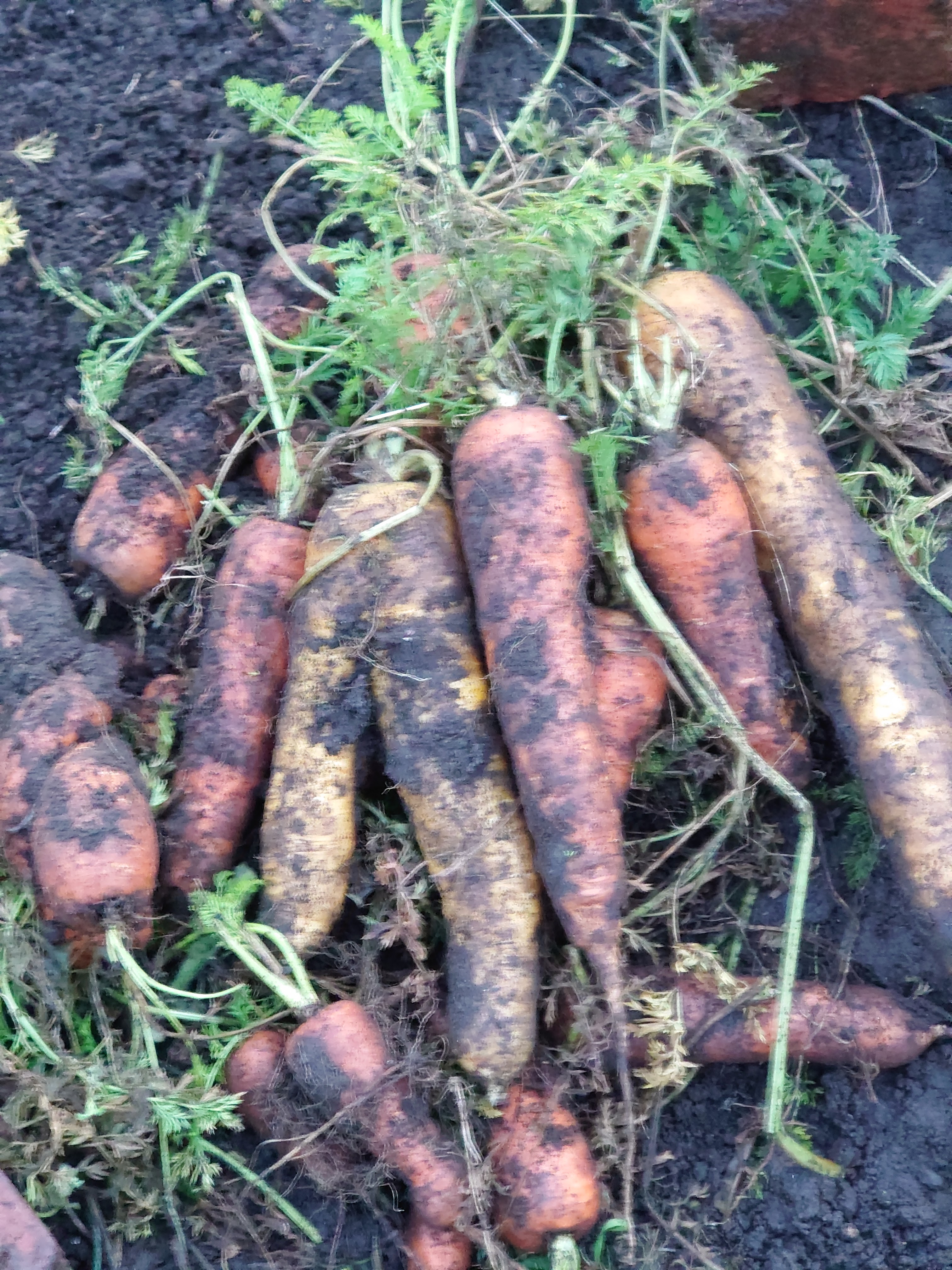
Carrots (protected by straw and netting)


and leeks.


Here are some breads to bring some winter cheer too.

Cinnamon Buns

French Bread and Kulich

(The kulich is an Easter bread so a bit out of season, but I had plenty of dried fruit to use up from Christmas when I rather overbought.)  

Friday, 22 April 2022

Picking Up At The Plot

 I have been indulging my newfound interest in flowering plants and particularly wildflowers recently. Despite appearances I have been keeping up with the production of edibles too.  To bring the record up to date, here is a statement of the current state of play.

I went for alliums in a bigger way this year growing autumn and spring planted garlic as well as shallots and onions from seed. These were sown indoors in February .  The garlic has emerged and shallot and onion have been planted out on site yesterday and today. 


Broad beans sown in cells and planted out a month ago are now sitting pretty at the plot. 


Peas on the other hand have refused to be cajoled into germinating early. As a last resort I have started them sprouting in a jam jar in the kitchen and only "sown" them in cells after germination and exporting them to the greenhouse and then the plot.


Still on legumes I have sown 5 varieties of Dwarf French Bean into deep cells in the hope that the improved night temperatures will help them get started.


The greenhouse has been stuffed full each night with the paraffin heater lit on any night when the threat of frost is flagged up by the weatherman.  The main beneficiaries are flowers: Cosmos, Marigold, Lobelia, but also tomato, cucumber and pepper 


Tomatoes and Cucumber

Pepper Hungarian Hot Wax


I have attempted direct sowing at the allotment but tend to hedge my bets by using up remnant seed supplies (open packets from last year or out of date ones).  This way I don't get upset when they fail - although failure is also more likely as a result!  Parsnip, carrot, Swish chard have been experimented with in this way - and have all been resown recently..

Good Friday is a traditional potato planting day.  Easter Saturday and Sunday saw me getting all but the maincrop Rooster in. 

Potatoes in waiting


The patch allocated to potatoes in my rotational plan still had "spring" cabbages at one end and leeks at the other.  Now that's what I call bad planning! The leeks are going into the cookpot.

The ground for runner beans, celery and celeriac has been thoroughly prepped with plenty of buried organic matter.  The celery and celeriac have been growing on at home

Celery and Celeriac  - Can you tell which is which?


 but the runner beans have yet to be sown.  The courgettes squashes and sweetcorn haven't been sown either yet, but I have recently prepared a bed for them too.  My method is to bag all my weeds and trimmings in old black lined compost bags and leave them for a year or two to rot down in the hope that after another year buried underground any weed seeds will not be viable.  This keeps all the nutrients recycled on the site - all except the edible part of any crops.  

Weed suppression is something I take very seriously.  The best method is to have a crop growing but failing that deployment of weed suppressant fabric in the early part of the growing season saves hours of repetitive weeding.  As the sowing season progresses so the aesthetically unpleasing fabric gets rolled back. 

Brassicas tend to be at their best late in the growing year. None more so than purple sprouting broccoli which is currently in full production mode. 


 One again my lack of planning means the row of PSB plants is right in the middle of this year's carrot patch (under the fine mesh).  The PSB needs nets to keep the pigeons off while the carrots need fine netting to keep the carrot root fly off. so it is a bit of a logistic nightmare to cater for them both simultaneously.  As the early carrot sowing show no sign of germination yet perhaps there is no imminent prospect of running out of space just yet - the main crop carrots can wait until the PSB harvesting season is over.


This years brassicas and leeks are coming on at home in readiness for planting out. It iis going to be busy for the next month or two!


Early season brassicas

Leeks


Saturday, 29 January 2022

New Year Cheer

 January flowers are such a rare thing. Thank goodness for the witch hazel


Winter Flowering Cherry


and Winter Jasmine


The bulbs are sprouting green leaves but not even the snowdrop will manage to put in an appearance before January is out.

And on the subject of bulbs I have this week planted 3 rows of garlic at the allotment (to add to the autumn sown ones).  Back indoors I have sown 32 broad beans into deep root trainers.  These will go into the greenhouse once they emerge and on to the allotment in due course.  Yes spring is just around the corner.  Next week will be busy now that I have looked out my seeds for early sowing! (Leeks, onions, shallots, tomatoes and chilli, as well as lobelia .

Friday, 20 August 2021

Allotment Tour Summer 2021

It is a sure sign of summer progressing when your fennel is ready for harvest.  After a summer where my focus has been elsewhere I realise it is time to do my "warts and all" tour of the plot. 


The parsnips are progressing steadily regardless of the stop start weather.  Alongside I have some second sowing of  autumn crops where the elephant garlic was.


The fruit cage is looking very green where the gooseberries and redcurrants are, A really good redcurrant crop but only a few gooseberries. I might have been a bit vigorous with my winter pruning?  The blackberries and autumn raspberries behind are yet to come. The two summer varieties are finished


Spring planted Onion from sets are flopping over of their own accord.  The early leeks behind show no such tendancy. 


For the first time I have tried to grow onions from seed too.  They are behind the celery and celeriac in this bed.  (It is also the first time I have tried to grow celery)


Moving along to the brassica patch there are three distinct phases as indicated by the height of the plants. The early cabbages and cauliflower are all gone but the Brussels remain tall and now suitably distanced. 


Further along the beans are hitting their peak.  Both Runners.

and Dwarf French


The winter squashes are the sea of green next door to the beans - although there are some flowers.  Fruits?  So far three marrow sized courgettes.


The foreground bare patch here is where the peas were and are now sown with winter leaves (Land Cress , Claytonia and Lamb's Lettuce.


Bringing up the rear I have hedged my bets trying to establish an asparagus bed but growing strawberries in between - at least until the asparagus gets going. It was grown from seed. (The rhubarb blueberries and globe artichoke just get on with their business year after year.)    


The final area is not very pretty,  It is the potato patch with nearly all of the tops cut off.  It looked like this in the middle of June.


But now it looks like this.


Hope you enjoyed the tour around my patch.


Sunday, 23 May 2021

Allotment Tour May

It is raining again today, but yesterday was a surprise sunny day.  I took the opportunity to take some snaps of the allotment.  First, appropriately, the potato patch.

The shaws are appearing above ground and very soon it will be time to mound them.
Beyond the potatoes is the fruit cage.  The first of the three bays was strawberries.  Notoriously these have to be moved around in order to avoid build up of disease.  So currently this bay is garlic,  Elephant to the left, ordinary to the right.  In between are two rows of parsnips which are indistinguishable from the germinating weeds currently.  But believe me they are there!


The remainder of the fruit cage is more conventionally raspberries and a mixture of currants and berries:


Reaching the turn at the end I am most pleasantly surprised by these autumn planted red onion sets.  I had given them up for lost but come the new year they have reappeared and are thriving.

Also at that end are spring planted onion sets (tent to the left ) Carrots (temple to the right) and leeks between them.  Next  is onions and shallots from seed (I went a bit mad on alliums this year) and the start of the brassica patch in front of that in the picture below.


Working back to the start I have covered the ground, temporarily with weed suppressant fabric.  This is going to be the the other half of the brassica patch and the legume/cucurbit patch which currently only has broad beans and a row of peas on the go along with some salads.  The runner bean poles are up in readiness but the runner beans are only now germinating back at home.


Broad beans (under netting)


For the sake of completeness here is the last section with strawberries and blueberries to the left, rhubarb to the right and asparagus bed featured in my last post in the middle.


So there you have it.  Together with the seedling nursery at home this is my vegetable home!  Hope you enjoyed the tour.


Thursday, 28 January 2021

Snow Joke

 Visiting the allotment today for the first time for a week the brassica patch has been decimated by the pigeons, taking advantage of the snow weighing down the netting. The Brussel sprout tops are gone but the sprouts on the stalk are untouched! The spring cabbages have taken a serious hit though.

The carrot patch cover was droopy, but completely pigeon proof.  

And the crop has benefited from  some frost protection from net and snow.  I dug up some monster carrots today:


Thank goodness I removed the netting from the fruit cage.


Here is an example of structural damage that can result from the weight of the snow if you don't.


The leeks don't look too hot but at least they and the parsnips don't appeal to the pigeons!


Monday, 4 January 2021

Winter Vegetable Bed - Judgement Day


It is time to revisit the 4 seasons square foot vegetable bed for the winter harvest.  The above picture was taken on 21st December and the ones below were taken today as the crop was lifted. ( If you want to see previous seasons posts just click on "4 Seasons" in the labels list.) 

Here is the day's harvest 
    

First prize has to go to parsnips. 5 roots out of 5 and all of them stout and long,  The only problem with them was that they grew so strongly that their leaves flopped over their neighbours, depriving them of light.


The leeks also showed well with 6 out of 6 transplants growing long if slender.  Some bonus parsley was also grown in the same square foot.


Celeriac was a bit bullied by the parsnip foliage, One tennis ball sized bulb (or swollen stem) would be a fine addition to a stew.


I left the swiss chard in the ground.  It has already provided several meals worth from earlier harvest. Light picking over winter progresses but there is plenty more to come in late winter and early spring before new seedlings will catch up with it. 


The pigeons had a good go at the Swedes but three survived and grew larger than tennis ball size after netting.  These would have happily waited for Burns' night on 25th January.


Beetroots were only salad size, despite the long growing season.  To be fair I think the larger ones were raided to make soup by one of the classes.  These are just the tiddlers left behind.  Also featuring in the picture below is the one mooli (white radish) that reached any size.  There were some tiddlers too but this crop  was the victim of being overshadowed by it's neighbour - parsnip.


Next is a real experiment: scorzonera.  Plenty grew.  The roots are long thin and whippy. Very hard to dig out without snapping. There is also the challenge of how to prepare them.  Once peeled the white flesh oozes latex and rapidly turns brown.  You need to turn to French cuisine to get tips on how to use this exotic ingredient.  That said, they grew well regardless of the cold.


The only no show was carrots, which was a victim of its popularity with badgers.  No sooner had they reached a reasonable size that the whole square foot was excavated and only the tops left as evidence!  I am just relieved that the badgers restricted their mining activities to these (and some potatoes).

It is only a shame that this exercise can only be reported virtually as it was designed as an educational exercise for the children to participate in,  Perhaps next year?