It is every allotmenteer's dream to be harvesting all the year around. With stored harvests like garlic, onions, and potatoes this can be a viable claim. But the fresh harvesting activity in winter is restricted to digging up parsnips, Jerusalem artichokes, leeks and carrots. What we crave by this time of the year is a bit of freshly picked greenery. The reality is that the best we can hope for is for leafy crops to withstand the onslaught of the winter chill and then spring back into new growth at the earliest opportunity. Here are a couple of candidates:
Miner's Lettuce/Winter Purslane
Seakale Beet/Swiss Chard
Last of the leeks and first of the onions
Spring Hero Cabbage
Just out of the (unheated) greenhouse are these winter survivors. They will be deployed in the open soon, probably with a bit of protection. The pigeons are keen on fresh greens too!
August sown All the Year Round Cauliflower Red Drumhead Cabbage Little Gem Lettuce
I think you can agree things are looking a bit forlorn on my visit to the allotment today. I keep wondering "Who is that" before remembering that the sunflower is being left for the birds. It is all that is left of the beans and cucurbits (and I think it came in with the plants having originally come from the birdfood at home).
One area still very much in production is the "Other Roots" which is mostly given over to carrots (under environmesh netting) because we eat so many of them over the year and they taste so much better than any you can buy. We haven't even finished harvesting half of them. as we pick them as we need them. I do hope we will get away with leaving them in the ground over winter. The net helps - and I will supplement that with straw if severe frosts are forecast.
Carrots under netting
The rest of the "Other Roots" are parsnips and scorzonera squeezed in at the end. These happily don't need protection. Celeriac had to be squeezed elsewhere (with the cucurbits) as space had run out!
Green tops of "Other Roots"
The Allium area only has leeks left. They have been intercropped with late lettuces, some of which are still on the go - along with the weeds.
Lettuces and Leeks
Harvested lettuces and leeks - and beetroot
Something else still on the go, by design, is curly endive - Pancalieri. I tried these last year tying a string around each plant to blanche them. It worked fine but some insects got wise to my plan and took up residence. So I am being a bit more relaxed (lazy) this year and I have left the rosettes unrestrained. They make great lettuce soup.
New this year is chicory. Rossa di Traveso (I think) is the one that has worked out best. Time will tell if they reach edible proportions.
Rossa di Traveso heads
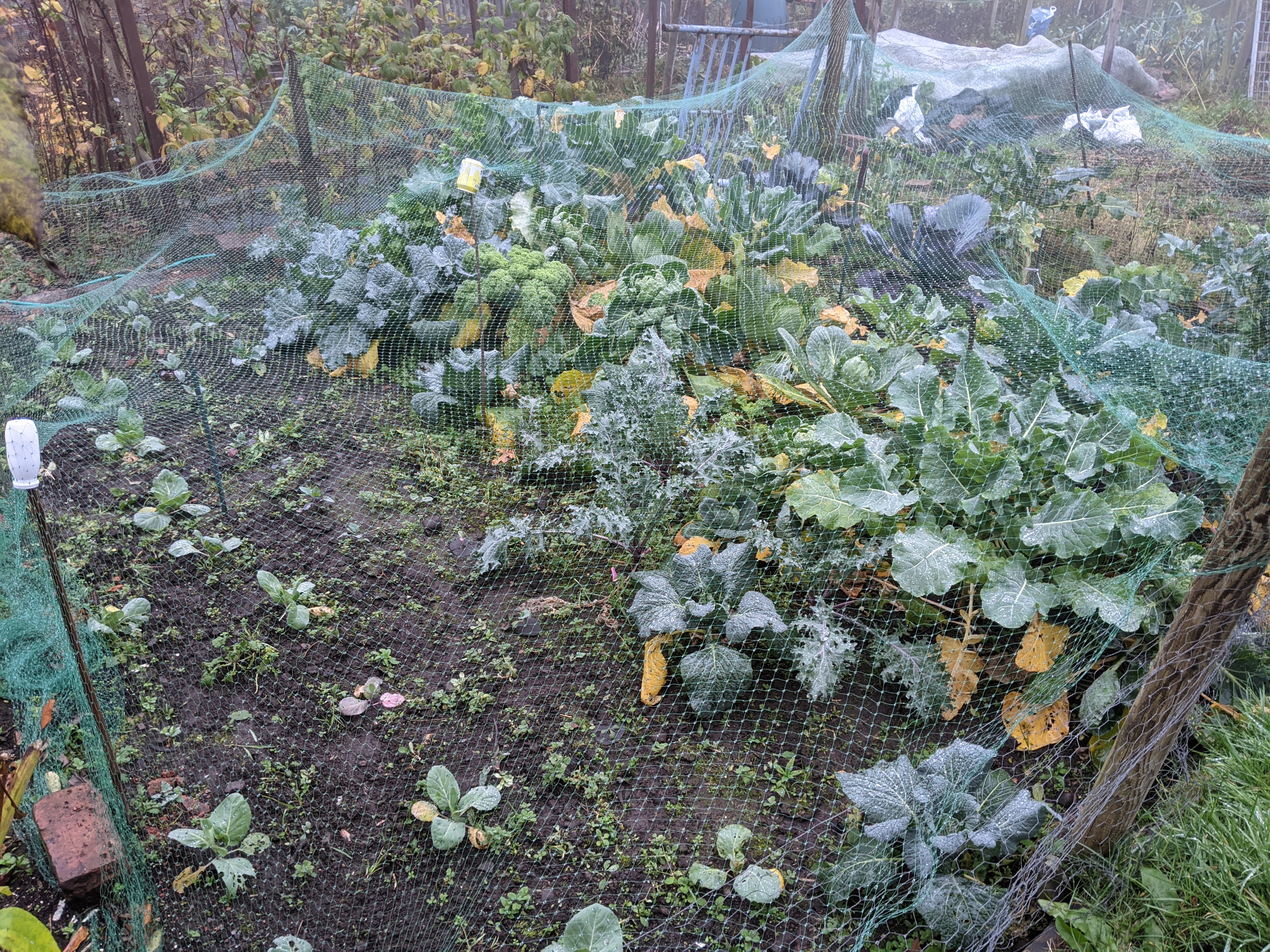
A mention for the more traditional brassica patch. The small plants are Spring Hero cabbages I am overwintering. There's plenty broccoli, sprouts and kale for the winter too, provided the pigeons don't gain access under that net.
Brassica Patch
So even though it is looking murky and winter is approaching there is still the prospect of more to come from the allotment.
Now the first beans are cropping it is time to clear away the broad beans and early peas. But not to worry, the replacements are ready to go out into the vacant space:
Lettuce, Endive/Chicory
I have got a bit carried away with my seed order experimenting with endive and chicory, as well as a wide range of lettuces. Hopefully this will mean a harvest extending into the colder months ahead. Here they are in the gap site. There are four of each variety which I have been careful to mark with a label. The lettuces are Marveille de Quatre Saisons, Lollo Rosso, Freckles and Gilaad. The endives are all called Cornet de (Insert Name of French/Italian Town) except Pancalieri which is a curly form of endive commonly called Frisee Lettuce.
Away from the Chicory/Endive/Lettuce confusion the bean and cucurbit zone is going hell for leather, except for those Climbing French and Runner Beans on the left which are being a bit coy. (The wigwam on the right is Barlotti beans)
Right in front is the row of Dior dwarf French beans which you can see in the first picture . I may have overcrowded the squashes which are now running rampant across their neighbours. A random sunflower has popped up in the middle of the picture. As you can see it is all green currently. This includes the potato patch which will soon be 'on the turn'.
Those yellowing in the foreground are some Charlotte I planted as an afterthought once the maincrop was already in.
Today, at the school garden, I lifted the fleece on the salad bed:
This is where the peas and beans grew this year, but then we planted out plug plants at the beginning of September. The fleece was deployed in the middle of October just before the first frost arrived.
In the foreground the Mizuna is looking nice and frilly. At the other end the Land Cress or American Cress is thriving :
Land Cress
This provides a peppery aftertaste. When the children were sampling the salads last week I warned them off this, and didn't provide any tasting samples for them. The result was that it became the highlight of the session with, I think, every child trying it just to prove me wrong, or to prove they weren't wimps!
There were four sorts of lettuce, with the Marveille de Quatre Saisons stealing the show with its rouged leaves.
Lettuces
The most prolific salad has been Winter Purslane (Claytonia, Miners' Lettuce). Still mild despite starting to flower.
Winter Purslane
I've tucked them all up again under the fleece and it is going to be interesting to see how they do when winter bites. I will leave them to see if we get a new flush come spring. As this is going to be the brassica bed next year there is no rush to clear the ground.
Just while I am on the subject of summer crops I can't resist showing of the solitary chilli from last year. It was an unsuccessful experiment for me spanning some four varieties. I did learn that they really do need to be treated as indoor plants in Scotland. The unheated greenhouse was ok for tomatoes and cucumber but the chillis just refused to grow. Add to this my over enthusiastic watering (in a vain attempt to encourage growth) and you can understand why they protested. It was only when I brought them back indoors that this one fruit eventually ripened.
As you see the leaves are protesting about the cold nights. Despite all this I will try again next year, in a limited indoor windowsill way, to grow chillies.
Another visit to the School Garden for this "vertical garden". It consists of a supported pallet with various second use plastic tubs wired to it. It was going to be "vertical veg" but it is a lot less challenging to find drought forgiving plants for the summer holiday if you don't restrict it to edible veg.
As an exercise in using a small space to grow in using recycled materials it has been a lot of fun. I think it might evolve a bit over the coming year with the lessons learned. It literally is lifting higher and higher!
In the past I have annually regretted my lack of foresight when it comes to successional sowing. But this year I have experimented with late sowings of cut and come again salads sown in half seed trays. The dates on these four are 19 August, 8 September, 26th September and 7th October (see below). The earliest tray has already been chopped and is regrowing. The second is currently being trimmed one section at a time and the last two are coming on nicely. Looks like our lunches will continue to be pepped up for a few weeks yet. Although this picture has been taken in the greenhouse the trays have been sitting out in the elements and have only just been moved inside now that the tomatoes and peppers have been cleared out my small greenhouse.
While I am on the subject I will admit that the successional sowing at the plot has been a little disappointing. Second and third sowings of beetroot, lettuce, pak choi, even leaf beet have produced very patchy or non existent rows - probably as a result of all the rain and the resulting slug action. In future I will sow more thickly to allow for poor germination and heavier predation.
Sometimes it is a good idea to sow more more more.
There are signs that summer is coming to an end, so here's a celebration of the veg patch at it's best before the turn.
Squash Carrots Jerusalem Artichoke and Sweetcorn
The Jerusalem Artichoke is taller than I can ever remember it. 9 ft. If it gets windy I will have to chop it down to size even before the frost burns the tops. Nestling behind those leave s in the foreground are some happy looking fruit:
Sharks Fin Melon and Kabocha Squash
Main crop potatoes Rooster being lifted
It has been a fabulous year for potatoes. Yields have been massive, but wet conditions also mean more pest damage.
Brassica Patch
Already Cauliflower Cabbage and Kale. Plenty more to come right up to the Purple Sprouting Broccoli next March.
Fill in Salad patch where the broad beans were
Uniform carrots
The most sensitive crop appears to be the French Beans. They stole a march on the runners but are not lasting as well. The runners are just going mad!