I think you can agree things are looking a bit forlorn on my visit to the allotment today. I keep wondering "Who is that" before remembering that the sunflower is being left for the birds. It is all that is left of the beans and cucurbits (and I think it came in with the plants having originally come from the birdfood at home).
One area still very much in production is the "Other Roots" which is mostly given over to carrots (under environmesh netting) because we eat so many of them over the year and they taste so much better than any you can buy. We haven't even finished harvesting half of them. as we pick them as we need them. I do hope we will get away with leaving them in the ground over winter. The net helps - and I will supplement that with straw if severe frosts are forecast.
Carrots under netting
The rest of the "Other Roots" are parsnips and scorzonera squeezed in at the end. These happily don't need protection. Celeriac had to be squeezed elsewhere (with the cucurbits) as space had run out!
Green tops of "Other Roots"
The Allium area only has leeks left. They have been intercropped with late lettuces, some of which are still on the go - along with the weeds.
Lettuces and Leeks
Harvested lettuces and leeks - and beetroot
Something else still on the go, by design, is curly endive - Pancalieri. I tried these last year tying a string around each plant to blanche them. It worked fine but some insects got wise to my plan and took up residence. So I am being a bit more relaxed (lazy) this year and I have left the rosettes unrestrained. They make great lettuce soup.
New this year is chicory. Rossa di Traveso (I think) is the one that has worked out best. Time will tell if they reach edible proportions.
Rossa di Traveso heads
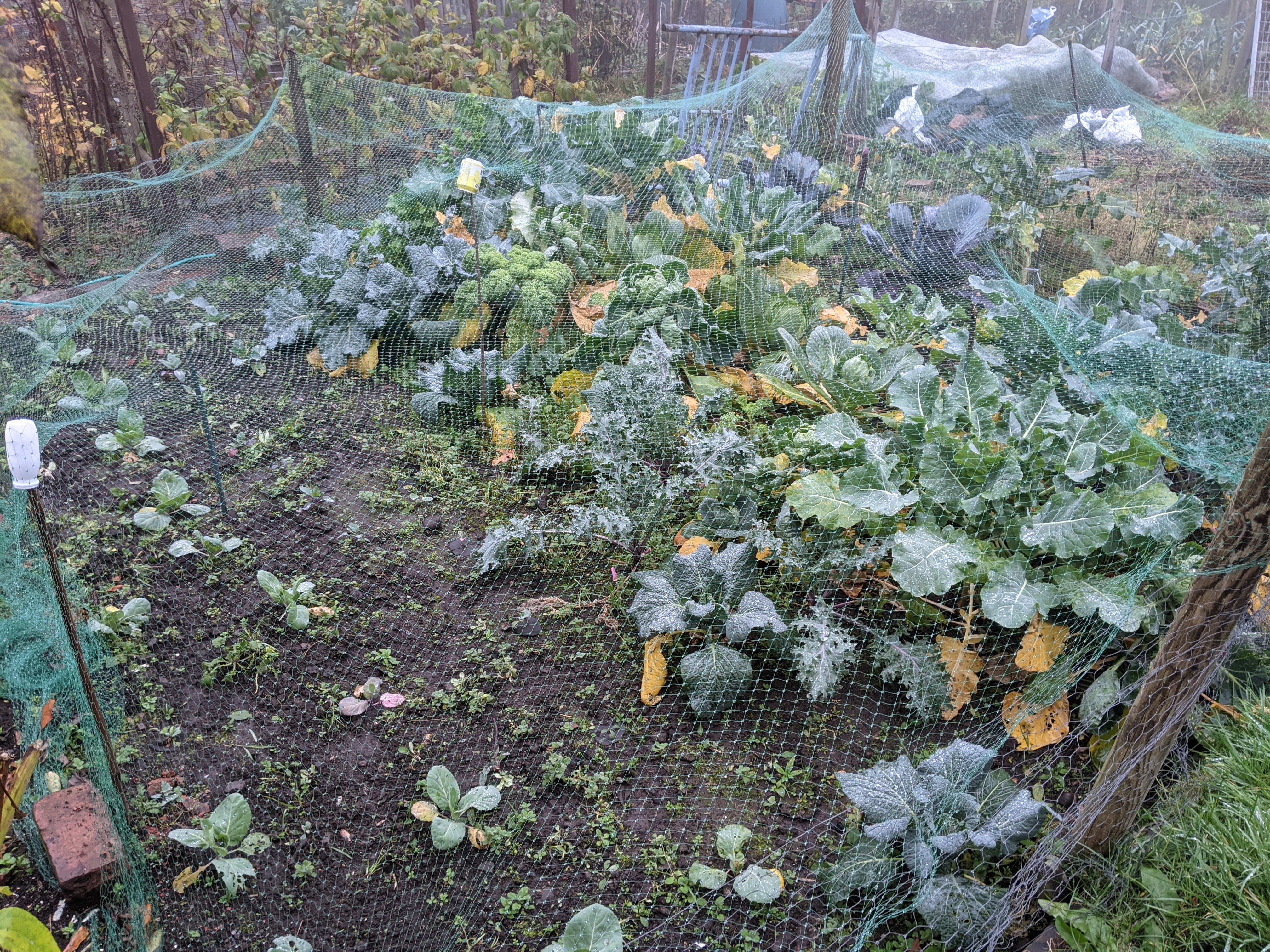
A mention for the more traditional brassica patch. The small plants are Spring Hero cabbages I am overwintering. There's plenty broccoli, sprouts and kale for the winter too, provided the pigeons don't gain access under that net.
Brassica Patch
So even though it is looking murky and winter is approaching there is still the prospect of more to come from the allotment.
The children return to school today and here is what will greet them in the school garden:
Now it is time for a spot the difference quiz:
A
B
Aside from the net to keep the pigeons off the kohlrabi, the difference is that a mature bulb of Florence fennel along with its feathery plumage has been removed by an agency unknown (middle left square foot) leaving a much weaker bulb. I hope this remaining specimen will grow on now its competition has been removed.
These are in the "Autumn" square foot bed. The neighbouring "Winter" bed is already full to brimming. It is the Swede that has been ravaged by the pigeons here (and now has a net over it)
You would have thought a tomato in a bucket in a greenhouse would be safe?
Well you would be wrong. Somebody selected a specimen from the back of this greenhouse . Curious because - as you can see the fence is higher than the greenhouse (7 or 8ft high)
Now before the bell rings don't forget the neighbouring wildflower meadow. I think it is high time for a haircut!
It's a strange thing when growing a square foot crop: The last thing you need is a runaway success!
To go back to the start. What better plan for a school garden than to show how vegetables can be available for harvesting the whole year around? Space of course is limited so the square foot gardening concept is ideally suited. A four metre by one metre bed was duly divided into 4 one metre square beds and slate labels made up accordingly. The idea is that each 1 metre bed is divided into 9 square foot beds. This can be done permanently with wood or slate. Alternatively a wooden 'noughts and crosses' or hash frame can be temporarily deployed to help with the spacing when sowing or planting.
Of course the real challenge is the sowing/planting plan - and the timing. One year in and here is a season by season report.
Spring - Photographed 18/9/19
Spring sowing plan
Winter
Purslane
Celeriac
Kohlrabi
Swiss Chard
PSB (Rudolph)
Beetroot
Swede
Leeks
Parsnip
Spring has suffered from being raided in December for the School Christmas Bazaar. The celeriac, kohlrabi, swede and celeriac were just too tempting when you knew you had a ready market for these crops which might not survive the cold temperatures or the predations of pigeons or soil borne pests. Not surprising as nearly all of the crops for spring harvesting are already mature before the year end but are left to hang on until the target date of 15 March.The PSB was not planted out because it was realised that it would bully all 8 of the surrounding crops and deprive them of light. Parsnips were the real surprise as they thrived in the limited space given to them. The downside was that their leaves flopped languidly over the neighbouring Spring and even Summer squares. The beetroot and leeks in particular suffered. The winter purslane seed failed to make any headway or got eaten before getting established. Swiss Chard is a real asset to any seasons planting. Cropping is the only issue as it is harvested a bit at a time and the soft leaves and fleshy stems are not easily transportable. There is a reason why supermarkets don't supply Swiss Chard and this is it.
Summer planting plan
Lettuce
Broad Bean
Onions
Peas
Elephant Garlic
Strawberry
Radish
Spinach
Rocket
Despite appearances from the late season photo Summer was very successful. The broadbeans cropped well but then had to be removed so as not to shadow out the rest. Lettuce grew and then bolted. Peas rocket and radish all did the same. The Strawberry is the only perennial in the whole 4 beds and is of course a dwarf variety. Both onions (from sets) and elephant garlic were the surprise winners for the Summer bed, yielding respectable quantities for the minimal space given to them (see below )
Autumn planting plan
Fennel
Cucumber
Lettuce
Beetroot
Tomato
Peas
Leeks
Dwarf French Beans
Carrots
Tomato (Totem) was the runaway winner in the Autumn bed. Despite its "dwarf" label it had to be restrained. Neither cucumber nor peas could compete. On the plus side it fruited well. Carrots were the surprise success here (although they would have been better if thinned more) Fennel was a no show replaced by a late sowing of coriander.
Winter planting plan:
Leek
Coriander
Kohlrabi
Beetroot
Swiss Chard
Swede
Carrots
Mooli
Parsley
Brassicas are great winter vegetables but given the space they need the leafy ones are not suitable for square foot gardening. (We do have a separate brassica only bed next to the 4 seasons bed). Root and stem brassicas like mooli, Swede and kohlrabi are good for this purpose, although the mooli was sown too late to reach a respectable size. Some crops (Swiss chard, beetroot) seem to suit nearly all seasons. Leeks might be another candidate for that accolade - except that this year they failed to perform wherever they were planted.
So many lessons learned this year. We plan to run the experiment for another year with the possibility of building on our experience. Seasonal greetings to you all.
At -6 C it has been the coldest night so far and I am reluctantly accepting that we have moved straight on to winter mode.
One autumnal novelty that has worked a treat this year is Endive Pancalieri. It tolerates cold and thrives just as all the usual lettuces are grinding to a halt.
It looks like a loose leaf lettuce but has serrated leaves rather than the rounded oakleaf we are used to, and is sold by the supermarkets in bags as 'Frisee'. Although the leaves are green they are best blanched in order to minimise the bitterness that can develop as the temperature drops. Here is the result of my experimentation:
The crisp and sweet blanched stems are encouraged by holding the rosette up with a loop of string. In the row of three below the middle plant can be seen before and after tying up.
Before
After
The loop can be lowered for harvesting and then pulled back up again if the whole plant is not being harvested at once. Meantime the next rosette can be tied in readiness for harvesting in a week or two.They are quite voluminous and the stems seem to cluster in groups even though I am sure each rosette is just one plant.
As these are across town at the allotment I am not sure they have survived the current frost, but so fare they have been a roaring success and I will be growing them in future years so as to extend the salad season into the colder months.
p.s. Endive is a member of the chicory family. I am also growing some chicory proper to be dug up and then forced for 'chicons' still later in the growing year. Watch this space!
Well lots of them really. The picture shows an unpacked delivery of plug plants received by the School on Tuesday from Rocket Gardens based in Cornwall. Today they were planted out into the garden beds by the children under the supervision of the Garden Team. Every space freed up after summer harvesting has been filled with Lettuce( 4 varieties) Corn Salad (Lamb's Lettuce), Winter Purslane, Spring Onions, Cabbages (2 varieties), Kale (3), Pak Choi, Mizuna, Broccoli, Turnip, Mustard and Perpetual Spinach. Custody is now down to us - and the vagaries of a Scottish winter!
I was impressed with the previous May delivery too. It included courgette plants. Despite the change in latitude they took off after being planted out and produced fruit before the summer holiday (end of June in Scotland). Despite a dose of powdery mildew they are still producing large fruit now! The School obtained the plants for free as an award under the RHS Gardening for Schools Scheme, but I have to say that the plant quality and service has been most impressive. It would be invaluable for anyone stealing a march or playing catch up after falling behind on their sowing schedule.
It's the last week in September and the nights are getting colder (and longer). The runner beans are still flowering and podding.
Time is running out for the sweetcorn:
The Kabocha squash in the the foreground never really got going. But going like clappers still this row of courgettes
The Brassica patch is coming into it's own
In the background the autumn raspberries (Joan J) have responded to frequent picking by producing more and more fruit throughout September. They have been great. The blueberries have taken fright at the colder nights and stopped in their tracks.