Thursday, 29 October 2020

Freedom for Worms


Freedom !

Looking back I realise that I started my "worm farm" back in April 2019 See  Worm Farm Update.  It has been located in the garden shed and survived a winter (and two summers).  Today I dismantled it and liberated the residents... to join those already in the compost heap. 

I did feel bad about keeping the worms in a closed system where there was no escape, however the community seemed to be thriving so it can't have been that bad.   Incidentally the reservoir did not turn into a drowning pool as worms can survive under water for considerable periods of time.  

Maintenance consisted of topping up their food supply and draining off the liquor from the reservoir at intervals.  This worm pee was used as a liquid feed and I as much, if not moore than I needed, particularly now at the end of the growing season.

So if it was so successful, why am I dismantling it?  (I hear you ask). 

  •  It was after all just dreamed up to make use of some environmentally not very nice packaging.
  • There was a build up of white pot worms for a while that worried me.  (The more familiar reds did prevail in the long run.)
  • Tucked away in the shed (and being in a closed system)  I had to remember not to forget to feed them at least every few weeks,
  • I already have another worm farm.  It is called the compost heap, This is a dalek style one.  Most importantly it is open to the soil at the base, and the worms are free to come and go as they please.  Admittedly I lose the liquid fertilizer through the soil, but that is the only negative I can think of.  It looks after itself and is very forgiving of holidays, the seasons, and my memeory lapses.
So, as they say, "a no brainer".  Liberate myself by liberating the worms!


Tuesday, 20 October 2020

Wild in the Country

Fly agaric

The season for fungi is here for all to see.  I never pick (let alone eat) any.  Not having the expertise to identify more than one or two I would have no confidence that I wasn't poisoning myself and those near and dear enough to share a meal with.  When it comes to threats to life I like to keep it simple. I do however admire from afar and try to expand my knowledge.  So I am enjoying walks and the fungi are putting on a show just as the flowers are being snuffed out by the cold.  Here's a woodland flower (as you can tell from the flash being required) that I just had to learn about.  


It turns out to be Yellow Pimpernel (Lysmachia nemorum).  I can see the similarity to Scarlet Pimpernel,  except that likes open spaces and is famous for only opening when it is sunny whereas Yellow lives in the shady woods!


Back at the school it turns out that the council has cut down the wildflower meadow.  Not a problem at this time of year but we will need to reinstate the metal stakes and rope demarking the area.  (Someone pinched the bright blue rope that was used for this purpose). 


Wildflower Meadow at it's longest


Monday, 12 October 2020

Note To Self

 The cucurbits have curled up,  the beans have been, the lettuce is letting up - it's that time of year again.  Time to take stock.  What worked - and what didn't?


Worked                                            

  • Winter Squash
  • Carrots under nets
  • Potatoes
  • Raspberries
  • Blueberries
  • Tosca onions from seed
  • Late season lettuces and Italian Endive varieties


No Go
  • Sweetcorn - Three strikes and you are out.  
  • Spanish Flag (Ipomoea lobata) and Spanish Dancer (Linaria reticulata) - These belong in Spain and don't like the climate in Edinburgh
  • French Climbing Beans  - no competition for runner beans.  Dwarf French beans don't seem to be as sensitive.  Curiously Italian Barlotti beans don't seem to be as temperamental.  Mind you they are  grown for drying not for pods.
  • French Cornet Endive varieties.  Cornet de Bordeaux bolted every time.

Happy Potatoes


French beans left - Runners right

Tosca Onions


Monday, 5 October 2020

Vertically Challenged


10th  August

I was prompted to post about this vertical pallet garden after reading accounts of other more professional ones.  This is located in the school garden and consists of two posts driven into the ground with a wooden pallet slotted over them.  Containers are then wired to the pallet slats. Last year we tried a variety of plants, but this year the theme was a mass planting of lobelias.  What do you think?

The display was somewhat short lived. Either this is because lobelia roots don't like to be closely contained, or just possibly,  the feed of diluted worm pee was too high in nitrogen so they stopped flowering.  The lobelia in half barrels in the school playground are still flowering happily away so I venture to think the former. At any rate by the end of August they had stopped flowering. 


28 August

And just for the record here is how the vertical garden looked last year when still in development: There was a wider range of plants but none successfully overwintered, aside from the mint at the bottom.


I am not sure this experiment is worth continuing.  The watering regime was three times a week (to tie in with three fills of the bird feeders a week).  Even if it rains you need to water the lower tiers as they are in a rain shadow.  A cynic would say that this experiment has demonstrated why horizontal is the norm for gardens. 


Wednesday, 30 September 2020

Pumpkins on Parade

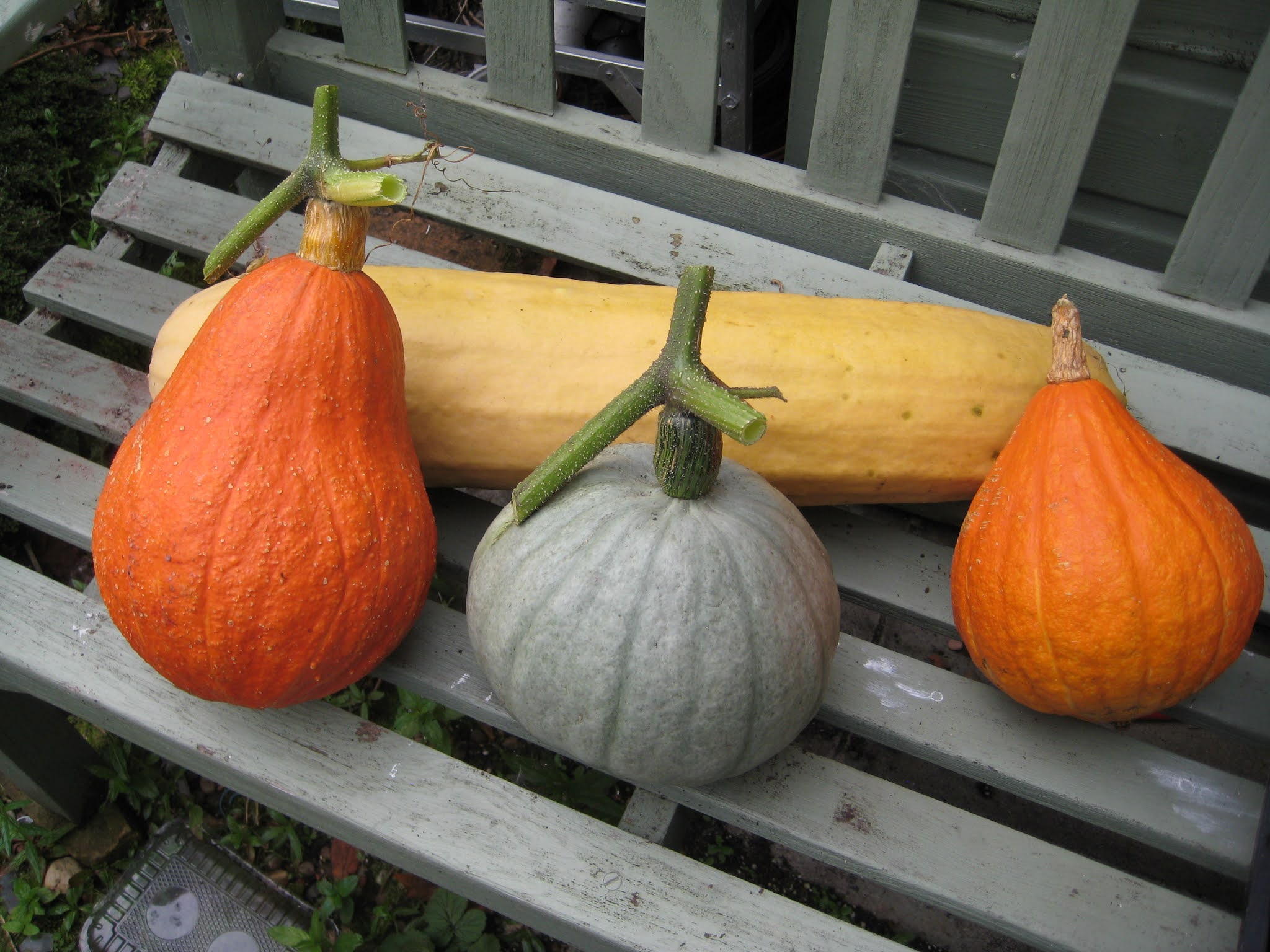
 Well winter squashes actually.  Here's this year's allotment crop


The long yellow ones should be Butternut F1 Hunter, but I think there must have been a mix up with the crossing as these look more like Banana Squash or even Spaghetti Squash.  I will report once it has been cut open and cooked.


Not sure whether this is Blue Uchi Kuri or Crown Prince.  That will teach me to grow such similar varieties.


Size isn't everything - These cheeky Uchiki Kuri are perfectly sized and one was the first to go under the knife


Very sweet and tasty it was too!


Thursday, 24 September 2020

Oooh What a Big One!


Now that the leaves are dying back the pumpkin patch is revealing this year's crop.  Special mention for the butternut squash (Hunter).  This one weighs in at over 4 kilos.  There is twin awaiting harvest but there is only so much carrying power between the allotment and home.


Then there is Blue Kuri and Golden Hubbard


And here they are together


There's plenty more to come.  As ever 


Tuesday, 22 September 2020

Confounded Composites


Dandelion ... or Sowthistle?


Dandelions ... or Hawkweed?


Q.When doesn't a dandelion-like  flowerhead belong to a dandelion?

A.When it belongs to a

  • Cat's Ear
  • Sowthistle
  • Hawkweed
  • Hawk's Beard
  • Hawkbit 
  • Lettuce
  • Nipplewort
  • Goat's Beard
  • Oxtongue
  • Viper's Grass
  • Colt's Foot
with multiple variations possible amongst these categories.  

I came across a yellow dandelion-like flower growing in my back garden several weeks ago and have been trying to narrow down which one it is ever since.  It has been driving me mad. 

Here are some of the features I have learnt are relevant to correct identification:

Time of flowering
Location
Habitat
Height
Stem - Hollow or not,secreting lactose or not,branched or unbranched,leafy or bare, green or purple, ribbed or not, prickly/hairy/bracted
Leaves - Shape/how attached
Rosette - The shape of the overwintering leaves at ground level
Flower - size, depth of colour, construction, 
Flowerheads - bunched or single/bracted or not/bract patterns
Fruiting head and Pappus (dandelion clock)

I tried to reduce these key features but it turns out that there is always another species whose tell tale characteristic is something you hadn't thought of. Here is my seemingly innocent candidate. It cropped up in the lawn and also in the wildflower bed.  Multiply branched at ground level and up the stems I would describe it as wirey stemmed (not round or hollow). 


The profile view is more telling because it reveals there are two sets of bracts one long and the other short (sepal like). 


 That makes it a Hawk's-beard. The Crepis family comprises some 200 siblings worldwide. 17 are said to be  native to the UK,  The most frequently found here are:

Crepis capillaris    Smooth Hawksbeard
Crepis vesicaria    Beaked Hawksbeard
Crepis biennis        Rough Hawksbeard


.


But searching for a basal rosette I am thwarted as there is only the remnants if there was one at all. 


The stem leaves are however making the case for Crepis capillaris  Smooth Hawk's-beard.


Here is the full SP on Crepis capillaris:

Introduced, warm season, annual or short-lived perennial herb to 75 cm tall. Stems are branched, with sparse, crinkly hairs. Basal leaves form a rosette, and are oblanceolate to lanceolate in outline, 10–25 cm long, 1–5 cm wide, margins toothed to runcinate-pinnatifid, glabrous or ± hairy. Cauline leaves are smaller, mostly narrow-lanceolate, stem-clasping, with acuminate auricles. Heads are 5–6 mm diam., and numerous, on slender peduncles, in loose corymbose panicles; involucral bracts are lanceolate, with sparse to dense white non-glandular and dark glandular hairs. Florets are all ligulate, the corolla yellow, often with pink or red stipe on outer face of ligule. Achenes are 2 mm long, lack a beak and have a pappus of simple white hairs. Flowering is in summer. A native of Europe, it is a weed of roadsides and disturbed areas.

So that's pretty clear?

This description along with the photo below have convinced me,

Source :

https://www.flickr.com/photos/macleaygrassman/15900577274/in/photostream/


At least I can say with confidence that this is a dandelion...


....cant I?