Friday, 24 January 2020

Worms and Weed Suppressant Fabric


Today I conducted a worm survey on my allotment.  I chose three locations. Firstly on ground which had been covered with weed suppressant fabric and was not used to grow a  crop in the last growing season.


Second was an uncovered patch that had gone a bit wild after the legumes and squashes had been harvested


The third sampling site was patch where onions and beetroot had been grown and was not heavy with weeds.


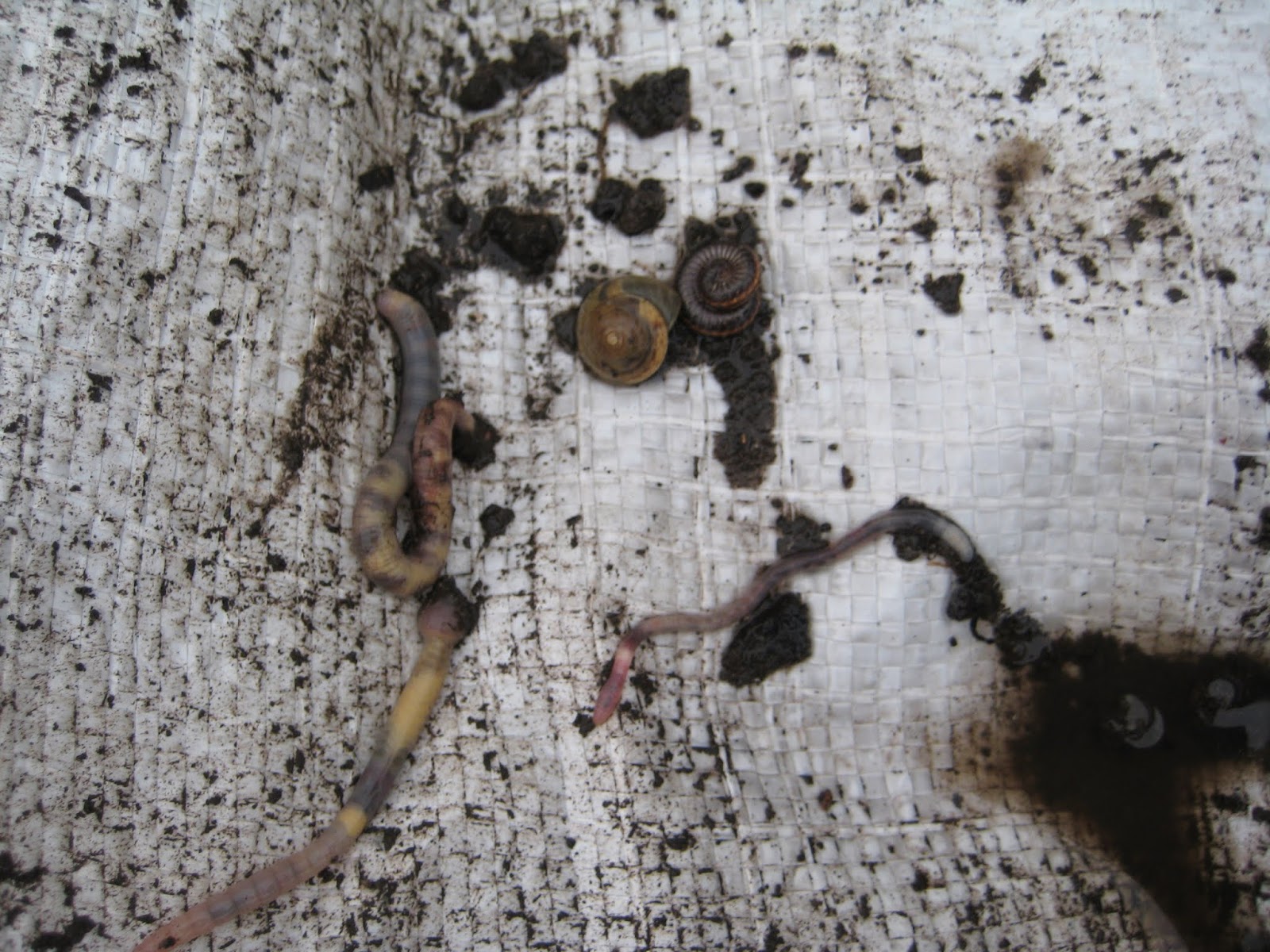
At each location I dugout a cube ( spade's width and depth) of soil onto a white plastic sheet.  Then I sifted through by hand using a spatula (a toy sandpit spade actually) and counted the worms that were big enough to be visible.  The first observation as that there were precious few earthworms at any of the three sites.  Sources talk about 5 to 25 worms per square foot, but I only counted a total of 8 (not counting a centipede, millepede, wireworm and a snail.

The fabric covered area was the worst, yielding just one very pink knotted worm (see top photo). The other two sites were close although the less weedy site just edged it at 4 genuine earthworm.

Overall I am worried at how few worms I turned up.  The original aim of this survey was to attempt to assess the effect of weed suppressant fabric on soil health, as indicated by the number of earthworms.  Just one worm is a fairly clear result.  This is not a result I welcome as I have found the fabric to be a boon, saving me lots of hours of weeding while producing good yields (of sweetcorn strawberries and brassicas for instance).   I may repeat my survey in wetter weather.  (The normal Edinburgh torrent has abated for the last week.) But it looks to me that I should stop using the fabric, except in desperation.


Wednesday, 22 January 2020

Back to Black


Today the weather was pleasant so I set about the task of emptying out the mature compost bin.  At the far end of our rectangular garden we have two 'daleks', one in each corner.  Our kitchen (and garden) waste gets added to one while the other is left to rot down - with the help of brandling worms. It is high time I did this as, with slower breakdown at colder temperatures,  the active bin has been brimming full for weeks.  The end result is, at most, a third of the height of the full dalek.  Now emptied the waste can be directed to the second bin where there is plenty of room. 

Here's the same bin at the beginning of the year (9/2/19)


With dalek in place:


I have bagged up the compost for now as I have yet to decide where the greatest need is:  flowerbeds or tubs.  Most likely I will avoid the option of taking them to the allotment as this involves transport. This black stuff is like gold dust. 


Friday, 10 January 2020

Four Seasons Square Foot Beds - Retrospective


It's a strange thing when growing a square foot crop: The last thing you need is a runaway success!

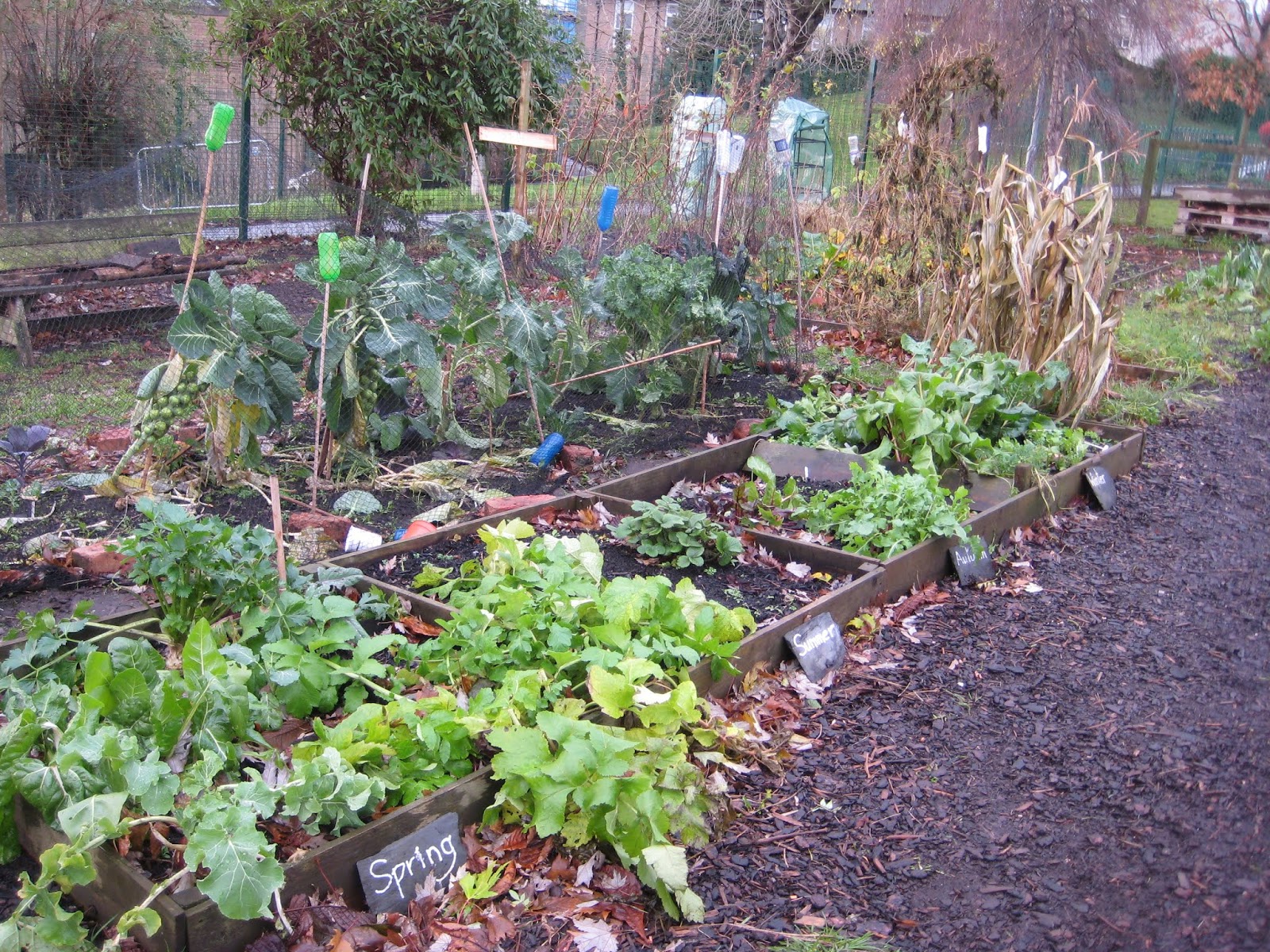
To go back to the start. What better plan for a school garden than to show how vegetables can be available for harvesting the whole year around?  Space of course is limited so the square foot gardening concept is ideally suited.  A four metre by one metre bed was duly divided into 4 one metre square beds and slate labels made up accordingly.  The idea is that each 1 metre bed is divided into 9 square foot beds.  This can be done permanently with wood or slate. Alternatively a wooden 'noughts and crosses' or hash frame can be temporarily deployed to help with the spacing when sowing or planting.  

Of course the real challenge is the sowing/planting plan - and the timing.  One year in and here is a season by season report.

Spring  - Photographed 18/9/19


Spring sowing plan


Winter Purslane Celeriac Kohlrabi
Swiss Chard PSB (Rudolph) Beetroot
Swede Leeks Parsnip

Spring has suffered from being raided in December for the School Christmas Bazaar. The celeriac, kohlrabi, swede  and celeriac were just too tempting when you knew you had a ready market for these crops which might not survive the cold temperatures or the predations of pigeons or soil borne pests. Not surprising as nearly all of the crops for spring harvesting are already mature before the year end but are left to hang on until the target date of 15 March.The PSB was not planted out because it was realised that it would bully all 8 of the surrounding crops and deprive them of light.  Parsnips were the real surprise as they thrived in the limited space given to them.  The downside was that their leaves flopped languidly over the neighbouring Spring and even Summer squares. The beetroot and leeks in particular suffered. The winter purslane seed failed to make any headway or got eaten before getting established.  Swiss Chard is a real asset to any seasons planting.  Cropping is the only issue as it is harvested a bit at a time and the soft leaves and fleshy stems are not easily transportable.  There is a reason why supermarkets don't supply Swiss Chard and this is it.  


Summer planting plan

Lettuce Broad Bean Onions
Peas Elephant Garlic Strawberry
Radish Spinach Rocket

Despite appearances from the late season photo Summer was very successful.  The broadbeans cropped well but then had to be removed so as not to shadow out the rest.  Lettuce grew and then bolted.  Peas rocket and radish all did the same.  The Strawberry is the only perennial in the whole 4 beds and is of course a dwarf variety.  Both onions (from sets) and elephant garlic were the surprise winners for the Summer bed, yielding respectable quantities for the minimal space given to them (see below )


Autumn planting plan
Fennel Cucumber Lettuce
Beetroot Tomato Peas
Leeks Dwarf French Beans Carrots

Tomato (Totem) was the runaway winner in the Autumn bed. Despite its "dwarf" label it had to be restrained.  Neither cucumber nor peas could compete.  On the plus side it fruited well. Carrots were the surprise success here (although they would have been better if thinned more)  Fennel was a no show replaced by a late sowing of coriander.


Winter planting plan:
Leek Coriander Kohlrabi
Beetroot Swiss Chard Swede
Carrots Mooli Parsley

Brassicas are great winter vegetables but given the space they need the leafy ones are not suitable for square foot gardening. (We do have a separate brassica only bed next to the 4 seasons bed). Root and stem brassicas like mooli, Swede and kohlrabi are good for this purpose, although the mooli was sown too late to reach a respectable size.   Some crops (Swiss chard, beetroot) seem to suit nearly all seasons.  Leeks might be another candidate for that accolade  - except that this year they failed to perform wherever they were planted.

So many lessons learned this year.  We plan to run the experiment for another year with the possibility of building on our experience.  Seasonal greetings to you all.
4 Seasons Beds on site


`

A Square Foot of Onions

Elephant Garlic


Swede

Kohlrabi

Beetroot

Celeriac


15

Friday, 20 December 2019

Nopcorn

Dried Cob
 It was the seed of an idea sown during a brainstorming session with the schoolchildren.

Child: I'm not really interested in any of the vegetables growing in the garden.

Volunteer:  What's your favourite food then.

Child: Well I like popcorn.

Volunteer: Well shall we try to grow that?

Child: Huh?!?!


Research suggested that the corn variety Strawberry was suitable for making popcorn and was also rather decorative being red instead of yellow. So we bought some seed and planted the resulting plants into the school garden.  And it grew:

Now we were not to know that 2019 was going to have a really miserable summer - especially the second half.  No one that I know of has had any success with 'normal' sweetcorn this year.  So I was quite chuffed when the odd couple of cobs grew to any size at all.  This was the best:


After letting the cob dry out thoroughly it was time today to try to 'pop' it.  

Attempt 1  Place the whole cob onto a really hot frying pan.  Result: charred cob and 2  audible cracks.  Pan ruined, kitchen smelling like a campfire. No popcorn.

Burnt but not popped
Attempt 2:  Blitz in the microwave.  Result - very much like I imagine the blitz was. Flashes of light and smoke and disturbing noises.  But once the smoke had cleared there was evidence of some genuine popping in amongst the burnt offering:


Next time I might go straight to the microwave method.

So an experiment with very limited results - probably not to be repeated.  I mean who would be that foolhardy?

Now here's the real thing:


Friday, 13 December 2019

RBGE Trip The Light Fantastic


After a week's delay due to bad weather we made it to the Royal Botanic Gardens of Edinburgh Christmas lights display.


This was better with the interactive music

Yes the trees were still there - and some featured,


A face to launch a thousand ships?

Hot House?

Pointilism?

Friday, 6 December 2019

December Crops - School Garden

Dadah!

4 Seasons Beds (Brassicas behind)
It's time for the harvest from the 4 seasons "winter" bed in the school garden.  The aim of these square meter beds is to demonstrate that there is something to be harvested in every quarter of the year. The winter harvest has been bolstered by produce from the brassica bed, notably brussel sprouts:


The school celeriac has rubbed salt into the wound by producing better celeriac than I have ever managed to grow on my allotment. (Despite the plants the from the same batch of seedlings)
Other pickings are:

Seakale Beet 

Swede or ' Neep'

Kohlrabi


Beetroot
Once you re picking parsnips it begins to feel a bit like Christmas:


Tuesday, 3 December 2019

Compostable Material


I'm starting an experiment today.

The question was posed: Are the claims of degradation of plastic alternatives justified?  Do they biodegrade as efficiently as they claim?


Today this bag has gone into my compost dalek, along with the usual kitchen vegetable waste.  I will leave all alone for three months when I will make my first check on progress. 

A few notes:

This was promoted as a people's science experiment but after volunteering I have heard nothing further from the organisers, so I am doing this off my own bat.

Biodegradability is different from home compostability and isn't on its own a cure for all aspects of the recycling problem - see the thought provoking article here  

I have been caught out before, most notably with teabags, which it turns out have a plastic element (glue?) to them.  Worse still the seemingly "paper" sachets some come in turn out to be plasticised and turn up years later when harvesting potatoes.