Wednesday, 10 September 2014

When You're Smiling...


The weather has turned and we are getting a last bite at summer. After going into shock in August some plants  are getting a welcome reprieve or a chance to ripen on the vine. 

Tomatoes

Sungold has been a a favourite as it even succeeds in Scotland and is ultrasweet.

Sadly we have experienced some "grinning"  for a second year. The books suggest that such skin splitting is due to temperature variations.  And while recent days have been sunny night temperatures have been low.


The only other variety I have grown this year was sold as San Marzano -  I've recently concluded that I was sold a pup. These are not plum tomatoes by any stretch of the imagination. They're not bad, some are ripening now, as you can see, so soon we will see what sort of sauce they make. Some of them have split too.


Others plants benefiting from the respite

Sunflower "Little Dorrit"

Fig Leaf Melon
The warm spell has come too late for the cucumbers...


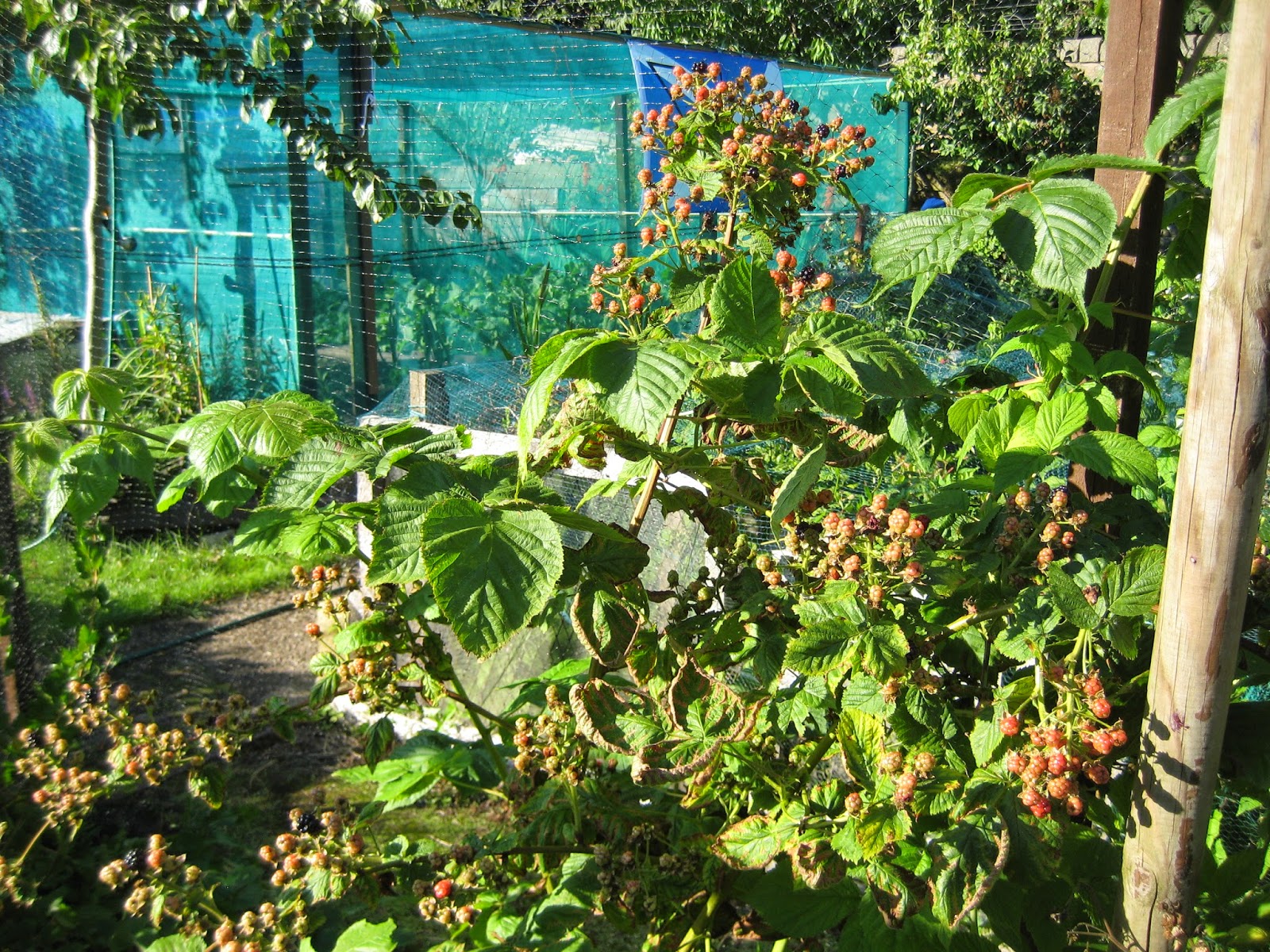
..but it is tailor made for Autumn Raspberry Joan J.


 Here's some other random pictures.

Our local mob of tree sparrows got a nasty shock the other day when this visitor turned up

Sparrowhawk
 I've had some queries recently about my brick beds. Well they're still going. Here's the late sown salads.


Another subject that I haven't mentioned in a while is baking. Here's a Boston Cake - 7 Cinnamon Buns baked together. A surefire winner.




Wednesday, 3 September 2014

Beanage - Vivre le Difference?


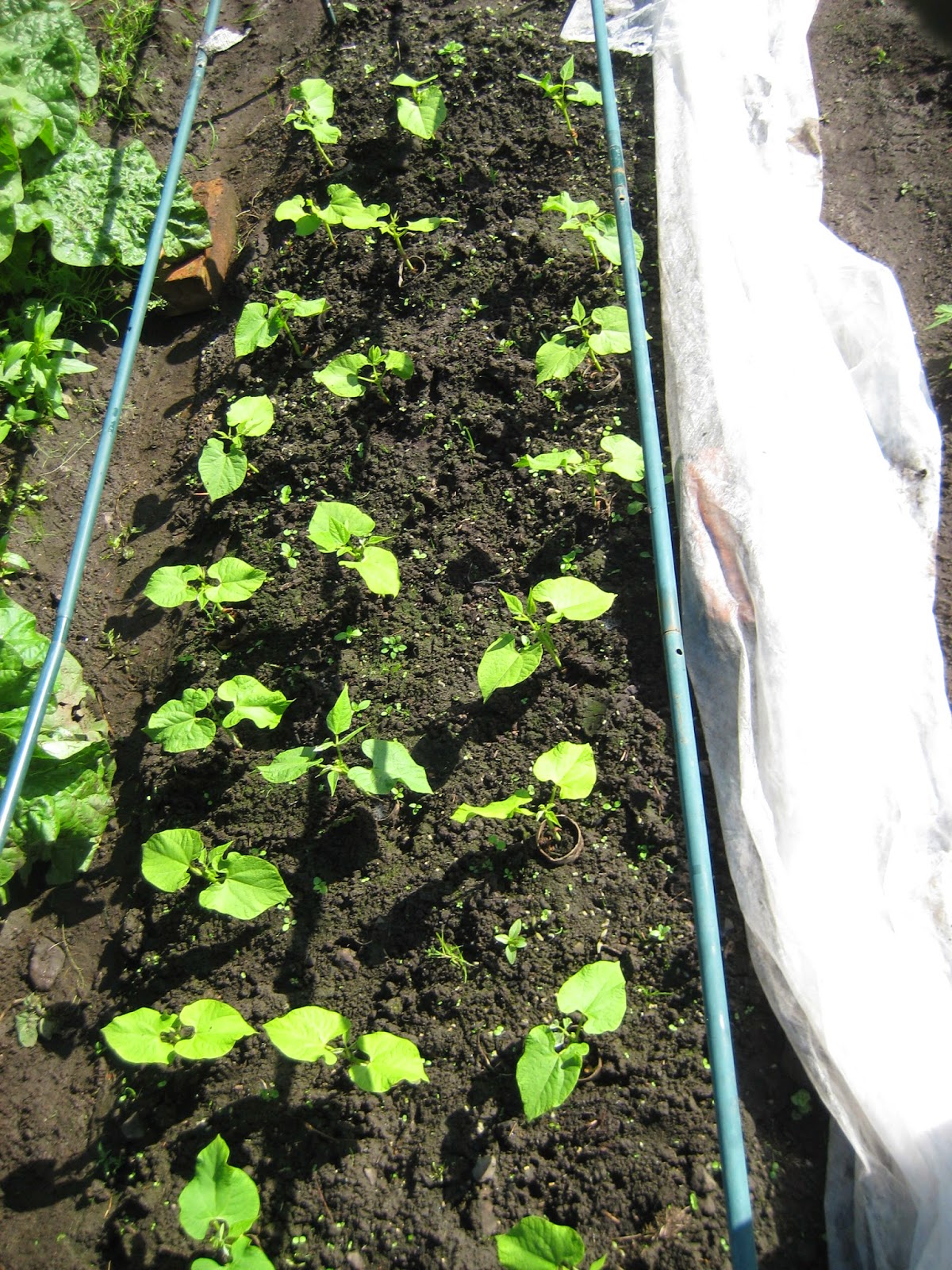
I'm growing beans in Scotland.  Here's the current state of play: Dwarf Beans...

24/08/14
...and here's how they looked in June:

Early June

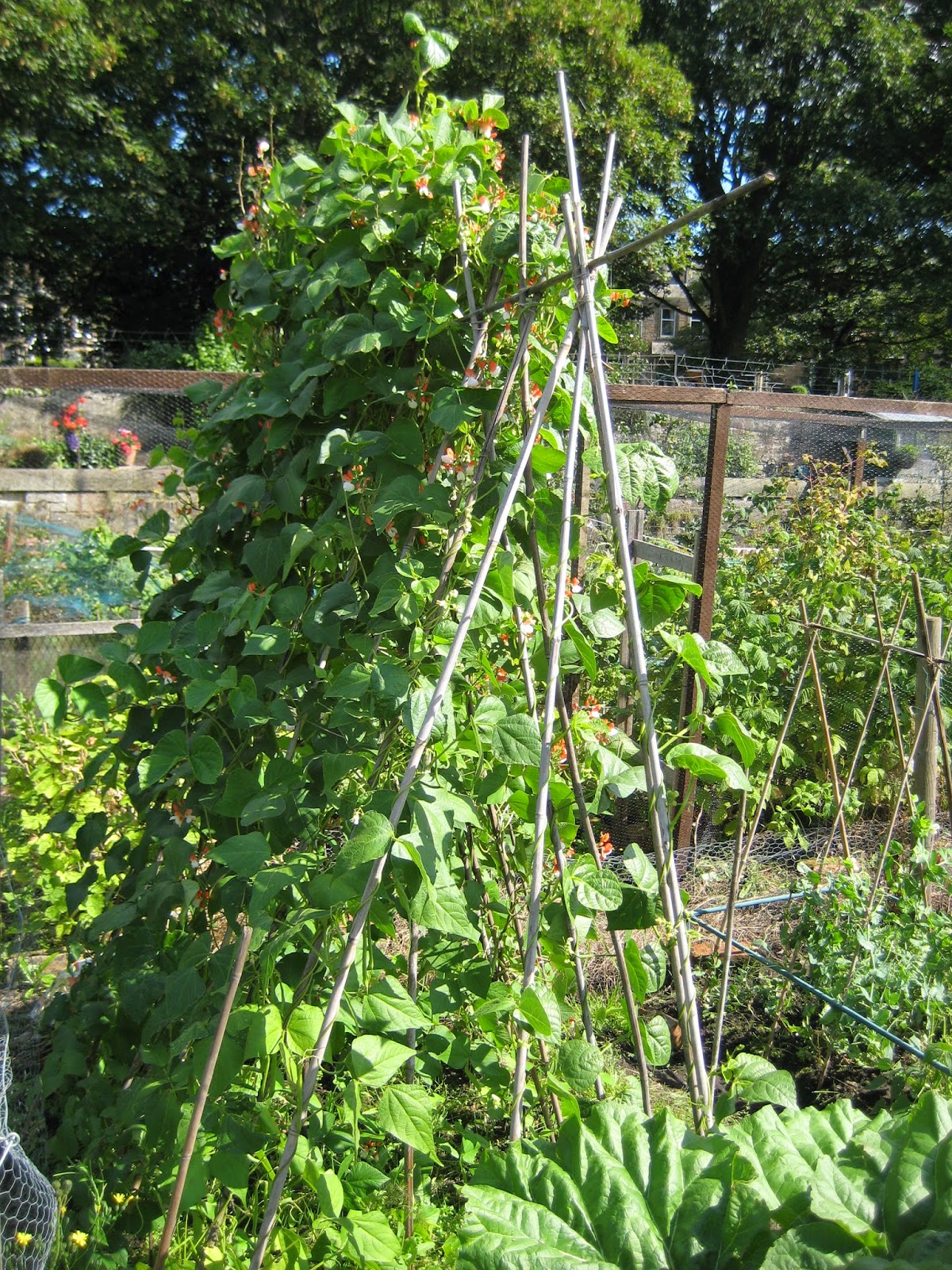
This picture shows my climbing beans (with the dwarf beans in the foreground)


and here's another angle. One end is not doing as well as the other. That's the French bean end which is so sparse. The healthy looking end is our stalwart runner beans Painted Lady.  These can be traced back to 1633 when they were imported from the Americas. The flowers are both red and white which purportedly give it the British name "York and Lancaster", being the opposing houses in the War of the Roses.  The only problem with this nomenclature is that the War of the Roses ended in  1488,  one hundred and forty five years earlier.  All the same they are the most resilient, reliable beans you can grow.   By contrast climbing French beans Blue Lake  and Cobra have not reacted well to the Caledonian climate.  Growth has been 'delicate' and pretty well static during the recent cold spell.  There have been some beans but not many, and a lot less than the runners. Their growing habit is also very erratic, wandering here and there In future I would make a point of tying each plant to its pole as they do wander. Having said that I'm not likely to repeat the experiment. On the plus side the beans we have had have been very tasty!


Another experiment has been dwarf French bean Mascotte.  These are very fine/thin, grow quickly and in abundance.  They all crop at once.  Successional sowing would be a good idea. And yes, with that proviso, I would grow these again.


Next to them is another stalwart: drying bean Canadian Wonder: I've arranges string to provide a bit more support as despite the close spacing (see below) some plants were flopping over. I hope that will do the trick.
Canadian Wonder now

Canadian Wonder in June

All in all it has been an interesting bean year.  The stalwarts have done better than the experiments.


Sunday, 24 August 2014

Monoecious


This year I have expanded my cucurbits from the usual one (courgettes) to four (add cucumber, Kabocha and Fig Leaf Gourd).

Up until now I have merrily removed all the male flowers from my courgettes and I have been doing the same for the melons/squashes/gourds/pumpkins. I remembered reading somewhere that if you left them the fruit might get bitter.  Doing a bit more reading, so as to figure out how to look after my new additions, I came across the word "monoecious" which derives form the Greek "One House".  In botanical terms it means that a plant produces both male and female flowers. Then the penny dropped: by removing all the male flowers there is the risk of making the plant infertile and fruit not setting properly or developing at all. Of course there is little danger of catching every male flower given that the plot is across town and the most I visit it is twice a week, but the couple of extra fig leaf melons I planted out under my nose at home have failed to produce any fruit. Now I think I know why - my over enthusiastic male flower snipping. No longer: now the "non productive" male flowers get to stay as long as they like.  Despite all this there have still been quite a number of young  fruit that have shown signs of rot and/or dropped off in the recent bout of cold weather.

Dioecious is where each plant produces flowers of just one sex. Examples are Holly,  Asparagus and (to my horror) Mulberry trees. This explains why our solitary specimen has failed to produce fruit to date!!!  Now I have to figure out which sex it is and order another sex specific tree.

p.s. You get some rather unhelpful results if you Google "How to sex a mulberry bush", but I have discovered that I need to wait until next spring and examine the flowers.

Sunday, 17 August 2014

Chilacayote

Get an allotment and travel the World!

Chilacayota Beverage
Anyone following my blog recently will know that I have been growing Fig Leaf Gourd, also known as Sharks Fin Melon and that it seems to like the growing conditions in Scotland.  In the picture below  there are three fruit at different stages:


They seem to prefer climbing to growing on the ground, but they can get a bit carried away, as with this one which is not so much sitting on the fence as growing right through it.


Curiosity (and the acceptance of the inevitable) got the better of me and I decided to harvest this melon even though it was not mature.  


Scanning the net it seems that in Mexico the immature fruit is known as Chilacayote and in one region, south of Mexico City (Oaxacan), they are widely used to produce a cooling drink of the same name. The idea is that you boil them in sugar water for a good hour and then liquidise the pulp.


Some recipes include pineapple, some include the the seeds and stringy pulp, but I decided to go for the straight strained version with a lot less sugar to get the flavour characteristic of the fruit. The results didn't look particularly interesting, but ... it's a shame the internet is not good on flavours.


There's something akin to that watermelon quality about this drink. All we need now is for the temperature in Edinburgh to get into the high twenties to justify making another batch!

Mexico is not the only place this melon has been.  It is is popular in the Far East  where the Shark's Fin name has stuck in honour of the similarity of consistency to that controversial ingredient, and in Spain where they make a jam named after the stingy characteristic of it's flesh when cooked : Cabel d'Angel - angels hair.  Next time I will be making this preserve from the fully ripened fruit.


And just in case you think I am shirking, I cleared the former allium patch today and sowed a green manure, so it's all clear between the potatoes (another American import) and the parsnips now!


Sunday, 10 August 2014

Lazing on a Rainy Afternoon

I left for the plot at 9 am this morning.  The rain started at 9:05 and by 9:15 I realised that I had to turn back. Its been raining all day since.  So instead of tidying up the now empty onion patch and cutting the grass on the path I have the opportunity to do a catch up on the state of the plot with a few pictures taken in the last week:

The biggest surprise has been the discovery of three Sharks Fin Melon/Fig Leaf Gourd fruit hidden away at ground level underneath all those leaves:
Surprise
Its already more than six inches across, as is this one, and another one. There are plenty more on the way too!


Not to be left out the Kabocha have started to bulk up too:

Kabocha

All in all there is a riot at this end of the plot. The Jerusalem Artechokes are now over 6ft tall.


 In the foreground the parsnip is coming on nicely, and behind them, next to the carrot tent there is a bit of an experiment: 

These are scorzonera:


They won't be ready for a long time yet, but I can't wait to try them.

The brassica patch is thriving on top of the weed suppressant fabric.


and the maincrop spuds are looking good:


Of course the earlies are looking very scruffy now by comparison:


but they are providing good eating.


At the other end the beans and the leeks are keeping each other company.  The broad beans are all finished, but the runners have started cropping and the Canadian Wonder are being left for drying. In the background of this shot the fruit cage has given up on both strawberries and summer raspberries (although the Autumn have yet to start). Thank goodness for rhubarb which just goes on and on giving.

The signs are that the blackberries won't be long now with a bumper crop:


So a lazy day, but on review I am well pleased with the plot this year.


Wednesday, 23 July 2014

Ooops Sharks on the Loose

I think I may have overplanted my curcubit patch. In there are Sharks Fin Melons, Kabocha Squash and courgettes. Also half a dozen sweetcorn. 


Not so long ago it looked like this. I think there has been an extra boost from the weather and the weed suppressant fabric.


And there are signs that the plants have no intention of stopping at the perimeter fence


Not to be left out the brassicas also appreciate the WSF treatment:


Given that I have returned from two weeks holiday the really impressive thing is the lack of weeds!  (Of course there are plenty enough left in other areas.)